
The following is an edited transcript of the Journal Club with Pearls & Marketing (JCPM) of July 21, 2026, with Charles Runels, MD.
>-> The PDF transcription of this live journal club can be seen here <-<
Topics Covered
- Penile Rehabilitation After Prostate Surgery
- The Full Post-Prostatectomy Protocol
- Adding Priapus Toxin® and Timing the Protocol
- Interstitial Cystitis and the O-Shot®
- PRP for the Testicles: Infertility and Injection Technique
- When to Offer Testicular PRP: Infertility vs. Cosmetic Use
- What’s Actually in PRP: Growth Factors and Cytokines
- PRP for Osteoarthritis: Healthier Patients Do Better
- The More They Pay, the More Likely It Works
- Marketing Pearl: Framing the Price of What You Do

Charles Runels, MD
Author, researcher, and inventor of the Vampire Facelift®, Orchid Shot® (O-Shot®), Priapus Shot® (P-Shot®), Priapus Toxin®, Vampire Breast Lift®, and Vampire Wing Lift®, & Clitoxin® procedures.
Transcript
Penile Rehabilitation After Prostate Surgery
Welcome to our journal club. We have three very interesting articles and a reminder about a marketing opportunity. We will definitely be finished in under 30 minutes today. Let’s start with this one about penile rehabilitation.1
The word penile rehabilitation didn’t really appear in the medical literature until around 2001,2 and the idea behind it is that if you have prostate surgery — and let’s say that you have a crystal ball and you know that you’re going to recover the blood flow that is temporarily compromised due to the surgery.
But during that time when there is no erection taking place, the penis, which is meant to be expanded, becomes fibrotic. It’s very similar to — or the idea is that that happens similar to — if you just took your arm and you bound it so that your elbow was bent all the time and you never extended your arm.
After a time, it would be difficult to extend your arm. You see that as part of the rehabilitation process if someone has a stroke. We’ve all seen it. Grandma has a stroke, and then physical therapy comes in and goes through, quote, “range of motion exercises,” where they passively move the arm or the leg through the normal range of motion, even though the muscle is not able to make that happen due to the stroke.
Then hopefully when the muscle recurs, there’s been no contractures. So you can think about post-op from prostate surgery as a development of a contracture because the penis has not been expanded. And so then it becomes like a balloon when you’re blowing up a balloon right before the birthday party, and it’s difficult to blow up, but you stretch it out, and by stretching it, it becomes much easier to blow up.
Surprising that that was a new idea as late as 2001. And the initial first-line therapy — they mention it here in this article, and I put this one, or will put it, in the handout section. It’s open source, so you can share it with your patients.
First line is just to give them daily Cialis so that what blood flow is there is maximal while you’re waiting for the recovery of the new blood flow and the neurogenesis.
And the other piece of it is a vacuum device, or a penis pump.
That’s what was on the scene when I picked up PRP for the first time and did the first injection of a penis with PRP. That was the protocol. Since then — that was 2010 — sixteen years later, many more studies have been done.
You can see these are all — they listed the studies and the adverse events, and there is the promise, or the hope, that these preliminary studies with PRP will turn out to be helpful. And if you notice, they also list it in combination with shockwave being better than just PRP alone.
=>Next Hands-On Workshops with Live Models<=
Of course, the last and third-line treatment is a penile implant. And although that sounds like a guaranteed thing, if you look at the research from people who get implants, it is true that the majority of them are happy, but there’s a significant number, between 10% and 20%, who are not happy; in one study, only 69% of men who got an implant said they would definitely do it again.3
So definitely worth trying the other treatments first.
The Full Post-Prostatectomy Protocol
So if I were designing the ideal treatment protocol based on this review article, it would be daily Cialis, daily vacuum device — which they said alone was not much better than placebo. But let me — let’s think about how that might be. If you have a match alone, you can’t really start a bonfire. If you have a match with wood, with some lighter fluid or diesel fuel, you can make a pretty big fire.
But the lighter fluid and the stack of wood without the match would not make a fire. It seems like a very simple idea, but I’ll just put that out there. It’s a way that I describe a lot of things in medicine. It’s the way I talk about hormone replacement. You can have all your hormones perfectly, but if your prolactin’s too high, you still won’t have much of a sex drive.
Everything could be wonderful with your thyroid, but if your testosterone is in the dirt, then you won’t have much of a sex drive. It can take more than one component. When I think about the penis pump, I think about it in the same way I think about Arnold — that he was in his prime when I was first learning to drive.
He was winning his bodybuilding contest. And there was only one book in my local bookstore, about weight training, and it was his Education of a Bodybuilder.4 So when he finally made the movie Conan, my friends and I were so excited that Arnold was making it big time, becoming a movie star. He had to lose weight for that movie because his muscles were so big that they made him look fat.
But did Arnold get big because he lifted weights or because he did hormones?
He obviously took extra hormones, but it took both, and I think of the pump as a way to maintain pliability, and I think pliability alone is not enough unless you’re doing something to encourage blood flow. But it just makes sense to me that the pliability, or the repeated stretching of the penis while you’re waiting for the blood flow to occur, would be synergistic.
(Anabolic steroids + Weight training) analogous to (P-Shot® + pump)
So even though the pump is the least supported by the research in this review article, I think it makes sense. It’s not harmful. Just make sure people who use the pump use it sensibly and don’t go overboard with it.
If you go here, I have a 23-minute video where I explain the idea behind the penis pump.
So right now, the best I can tell from this research and our experience — when I say “our,” I mean feedback from our group. I’m taking notes from you and your colleagues. It’s a penis pump once or twice a day for 10 minutes at a pressure between minus five and minus 10. Daily Cialis, either five or two and a half milligrams, whatever they can tolerate, plus a P-Shot® procedure, and, if available, shockwave.
Adding Priapus Toxin® and Timing the Protocol
And now I would add to that — which they don’t even really cover here — I would add Priapus Toxin®, because remember, at 100 units, they saw 40% of the men develop an erection that had long-standing ED unresponsive to PDE5 inhibitors — so people with long-standing type 2 diabetes or even spinal cord injury.5
=> Apply for Online Training for Multiple PRP Procedures <=
So the whole protocol would be Priapus Toxin® with 100 units of botulinum toxin, a P-Shot®, daily vacuum device, and daily Cialis, and a shockwave if you have it available.
I would recommend you not start the protocol until the urologist has discharged the patient. Otherwise, you get blamed if there’s a side effect, and the surgeon takes credit for the good results when it happens.
So you wait until the surgeon is completely finished— if you’re not the surgeon. We have urologists in our group. If I were the urologist, of course, I would start this within days post op. But if I’m not the one who did the operation, I’d just like to have one cook in the kitchen.
So when that urologist is done and says, “This is the best I can do,” then I will do that protocol, and I’ve seen it work when people have been years post-op and have gone through the protocol of just daily Cialis, and then I’ll put them back through the pump and the P-Shot® along with the Cialis, and they get great results.
Okay, so that’s the idea behind that one, and I’ll give you the article. It’s open source, so you can share that with your patients and let them know that you do this. It’s surprising, once you get past about 50, how many of your friends have had prostate surgery.
Interstitial Cystitis and the O-Shot®
I just bring this to your attention because we have people in our group who specialize in interstitial cystitis. We’ve covered quite a number of papers.6 This one is a nice review article, and there’s really nothing in here we haven’t talked about, but I like the way it explains it.7
It’s a good one to review if you haven’t looked at IC. And we have amazing results. I get call after call from gynecologists and urologists telling me that their IC patients, after years of — I mean, five, six, 10 years of pain — have great results after just a regular O-Shot®. You don’t even have to inject it into the bladder.
PRP for the Testicles: Infertility and Injection Technique
This one, I love this. I don’t know, probably 10 years ago, I injected my testicles a couple of times just to see what method I might use, and predicted this might be a thing, and now it’s a thing.
 Infertility is a big deal; If you look at what people are willing to spend more money on: The first thing is cancer treatment. Second place is infertility.
People will spend more money on that, because they want a child so badly, than anything else in medicine other than cancer.
They don’t really show the technique in this paper. I’ll draw a little diagram for you about how I’ve injected myself —not to make a baby, just to see what the technique might be.
This one’s open source too, so I’ll give it to you at the end of the call. So if you just take the testicle, you can feel the epididymis pretty easily, and you find the part that’s smooth, underneath.
And then you just put your PRP in a syringe with a luer lock and a twenty-seven gauge needle, and you come in from here (see video).
And you would think it would be awful, but there aren’t that many pain fibers. So it feels a little achy, like when you were hit with a baseball or fell on your bicycle as a kid, only not as severe. Or when you got vasocongestion-associated scrotal pain (blue balls) when you were aroused (if a man) and did not have ejaculation as a teenager (the equivalent in a woman is called vasocongestive pelvic pain, or “blue vulva” or “blue bean”).
So there’s an ache that goes away and is really just mildly uncomfortable. It’s not a big deal.
When to Offer Testicular PRP: Infertility vs. Cosmetic Use
I don’t know that this one’s ready to start advertising. I’ll tell you why I haven’t advertised it. I feel like we need maybe one more click of research. Well, let me take that back. If I had someone who was getting it for infertility, I think we have enough now to warrant doing it.
But if someone wants it just to increase testicular volume, or for cosmetic reasons, then I think you have to wait. Because if they developed testicular cancer, even though there’s no evidence that PRP is carcinogenic, that would be a bad day. As a matter of fact, last week we covered a paper showing that treating pre-malignant lesions in the mouth decreased the percentage that progressed to malignancy8, so who knows, it may actually decrease the risk of testicular cancer but I’d not offer this yet for cosmetic reasons.
We talked about similar research with breast cancer9 and lichen sclerosus10, where there seems to be a decrease, not an increase.
So it’s not just blind growth that happens with PRP. Some immune factors favor healthy tissue growth. But I’m not quite ready to make it mainline for cosmetic use in the testicle, though I think it’s come far enough that you could offer it for infertility.
What’s Actually in PRP: Growth Factors and Cytokines
Okay, I think we have one more paper, and then something quick about marketing, and we’ll call it a day. Hold just a moment.
And I’ll give you all these papers before I shut down the call.
This one also had a very nice review of what growth factors and cytokines in PRP are doing the work.
When we first started doing this — the P-Shot®, the Vampire Facelift®, and the O-Shot® back 16 years ago — we had no direct research. But we had a lot of research in the wound care literature talking about these growth factors.11
This is a very short list of the main cytokines and growth factors, but there’s actually over 30 of them if you look at the bench research. So we talk about that and point to the wound care and say, “This will probably work.” It’s so easy now, because we have so many papers — over 3,000 just about PRP in the female genitalia.
This one is the one that is really — I couldn’t download. It’s one of those where they made it hard for me to give them money. I spent 15 minutes and still didn’t figure it out. But it’s an important paper, so let me pull it up online for you to look at. It’s truly important to what we do.
PRP for Osteoarthritis: Healthier Patients Do Better
This one makes sense, doesn’t it? So they were looking at osteoarthritis, the treatment with PRP, but I think you could say it might apply to what we do.
Some of you are treating joint disease, and there was a man in our hands-on workshop this past week who is a sports medicine doctor who uses PRP as a tool and now wants to do sexual medicine.
Some are orthopedists in our group, and many of you are injecting, or family practitioners, injecting joints. As an internist, I did — some of you know my story. I was audited for being the number two doctor in the state of Alabama for the number of knee injections I did when Hyalgan first came out, and I was offering it to my weight loss patients.
If many of you are doing weight loss, and if you’ll just ask people about knee pain, almost everyone over fifty pounds overweight — really forty pounds overweight and over fifty years old — has a knee that hurts. And they’re grateful when you do something to make it feel better. Doing a PRP injection and combining it with an HA works beautifully.
And then they’re better able to keep their weight off because they can walk without pain.
Insurance is still going to want you to do cortisone first, even though it leads to more rapid joint destruction.12 That’s what I was audited for — I was skipping the cortisone step.
So they’ll most likely need to pay you cash, but maybe not. Maybe you can get it covered. But the point of this, both in the knee and, I think, in most likely any PRP procedure, is that if they’re just healthier, it’s going to work better.13
That makes sense. We’ve talked about that so much. But the other part may not surprise you, but I think it’s not talked about as much.
The More They Pay, the More Likely It Works
The more it costs, the more likely it is to work. There are two things that could go along with that. I’ll go back to when I ran a weight loss clinic. I found that if I gave it to people — these are people, as you know, who will ask you to do things for free — they had a much lower success rate.
Or if someone else paid for it — I learned that lesson the hard way. The spouse comes in and pays for the wife’s weight-loss program. She doesn’t really want to do it. He’s most likely pushing her to have it. So I never had — I shouldn’t say never. I seldom had the sort of results with free or highly discounted that I did with full price.
And one explanation is that if someone pays a lot, there’s a larger placebo effect. They want it to work better because they’re more invested. The other, and I think the more likely one, is that if they pay more, it’s a screen for the people who are more likely to participate with you because they want the result more.
People who got my weight-loss program for free weren’t all in. They didn’t do the walking. They didn’t do the meal replacements. That was the main part of it (20 years ago, before the new weight loss drugs).
I could do the hormone replacement for thems — that was easy. They didn’t have to work for that (a shot, pill, or pellet), but they were less likely to do the walking, the part they had to actually do other than take a pill or a shot, and they were less likely to use meal replacements as an appetite suppressant.
There wasn’t a behavior change.
Marketing Pearl: Framing the Price of What You Do
But I hope it makes you feel better about charging for what you do. You’re actually doing the person a favor to charge them. The way I talk about it when someone complains about the price, or asks about the price — which does happen — is, instead of comparing it to a free or a co-pay, I bring it out of medicine and compare it to something outside medicine, for example, consider the following:
Twelve hundred dollars, fifteen hundred dollars for an O-Shot®. That sounds like a lot, right?
And it is a lot compared to a $20 copay, but it’s also just two nights in a nice hotel, or it’s less than a transmission repair or a new set of tires.
So when someone says, “That’s a lot of money,” a good answer is to pull it to something they can relate to.
Part of the reason I quit being an ER doctor is that I realized, after a trip to the beach with my children, that I was being paid much less for running a full code CPR and central lines than I had paid the day before to rent a jet ski at the beach for one hour.
And I thought, “Hmm, there’s something not right about that.”
So I quit.
And I think with that, let me see who has a question and make sure that these links and papers are in your handout. I think the take-home message from this is that you’re actually doing people a favor.
And as far as the marketing piece goes, it’s to be ready to compare whatever it is you’re doing — find something of similar price outside medicine, and compare the benefits of your procedure to that thing.
Don’t see any questions, but let me make sure I’ve given you all the handouts. Okay. Yep, they’re there.
So thank you for being on the call. I’ll give you another minute to pull those out.
Okay, I think that’s it. Y’all have a great week, and thank you for being on the call.
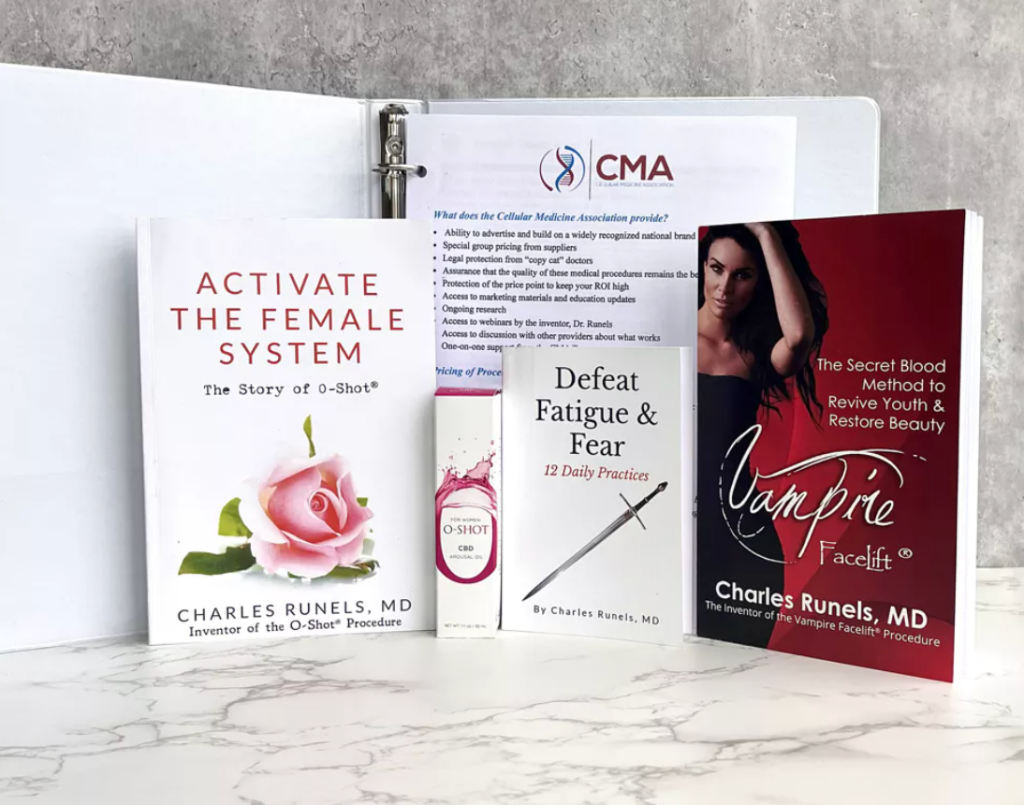
=>Benefits of the Cellular Medicine Association<=
=> Apply for Online Training for Multiple PRP Procedures <=
=>Next Hands-On Workshops with Live Models<=
References
“Arnold: The Education of a Bodybuilder: Schwarzenegger, Arnold: 9780671797485: Amazon.Com: Books.” Accessed July 26, 2026. https://www.amazon.com/Arnold-Education-Bodybuilder-Schwarzenegger/dp/0671797484/ref=tmm_pap_swatch_0.
Burke, Lindsay, Olivia Leupold, Sophia Perez, Jennifer Cheng, Heidi Prather, and Ellen Casey. “Fewer Lifestyle-Related Chronic Diseases and Higher out-of-Pocket Costs Are Predictive of Favorable Response to Intra-Articular Platelet-Rich Plasma Injections in the Treatment of Knee Osteoarthritis.” PM & R: The Journal of Injury, Function, and Rehabilitation, ahead of print, July 20, 2026. https://doi.org/10.1002/pmrj.70187.
Cervelli, V., L. Lucarini, D. Spallone, L. Brinci, and B. De Angelis. “Use of Platelet Rich Plasma and Hyaluronic Acid on Exposed Tendons of the Foot and Ankle.” Journal of Wound Care 19, no. 5 (2010): 186–90. https://doi.org/10.12968/jowc.2010.19.5.48045.
Chicharro-Alcántara, Deborah, Mónica Rubio-Zaragoza, Elena Damiá-Giménez, et al. “Platelet Rich Plasma: New Insights for Cutaneous Wound Healing Management.” Journal of Functional Biomaterials 9, no. 1 (2018): 10. https://doi.org/10.3390/jfb9010010.
Deng, Juan, Mei Yang, Xingyu Zhang, and Hongmin Zhang. “Efficacy and Safety of Autologous Platelet-Rich Plasma for Diabetic Foot Ulcer Healing: A Systematic Review and Meta-Analysis of Randomized Controlled Trials.” Journal of Orthopaedic Surgery and Research 18, no. 1 (2023): 370. https://doi.org/10.1186/s13018-023-03854-x.
Eichler, Christian, Jens Üner, Fabinshy Thangarajah, et al. “Platelet-Rich Plasma (PRP) in Oncological Patients: Long-Term Oncological Outcome Analysis of the Treatment of Subcutaneous Venous Access Device Scars in 89 Breast Cancer Patients.” Archives of Gynecology and Obstetrics, ahead of print, April 4, 2022. https://doi.org/10.1007/s00404-022-06416-4.
El-Shaer, Waleed, Hussein Ghanem, Tamer Diab, Ahmed Abo-Taleb, and Wael Kandeel. “Intra-Cavernous Injection of BOTOX® (50 and 100 Units) for Treatment of Vasculogenic Erectile Dysfunction: Randomized Controlled Trial.” Andrology 9, no. 4 (2021): 1166–75. https://doi.org/10.1111/andr.13010.
Giuliano, Francois, Pierre Denys, and Charles Joussain. “Effectiveness and Safety of Intracavernosal IncobotulinumtoxinA (Xeomin®) 100 U as an Add-on Therapy to Standard Pharmacological Treatment for Difficult-to-Treat Erectile Dysfunction: A Case Series.” Toxins 14, no. 4 (2022): 286. https://doi.org/10.3390/toxins14040286.
Giuliano, François, Pierre Denys, and Charles Joussain. “Safety and Effectiveness of Repeated Botulinum Toxin A Intracavernosal Injections in Men with Erectile Dysfunction Unresponsive to Approved Pharmacological Treatments: Real-World Observational Data.” Toxins 15, no. 6 (2023): 382. https://doi.org/10.3390/toxins15060382.
Giuliano, Francois, Charles Joussain, and Pierre Denys. “Safety and Efficacy of Intracavernosal Injections of AbobotulinumtoxinA (Dysport®) as Add on Therapy to Phosphosdiesterase Type 5 Inhibitors or Prostaglandin E1 for Erectile Dysfunction—Case Studies.” Toxins 11, no. 5 (2019): 283. https://doi.org/10.3390/toxins11050283.
Habashy, Engy, and Tobias S. Köhler. “Botox for Erectile Dysfunction.” The Journal of Sexual Medicine 19, no. 7 (2022): 1061–63. https://doi.org/10.1016/j.jsxm.2022.03.216.
Idres, Fatima A., and Michel Samaan. Intra-Articular Platelet-Rich Plasma vs. Corticosteroid Injections Efficacy in Knee Osteoarthritis Treatment: A Systematic Review. 2023.
Pourkarim, Reza, Mohammad Reza Farahpour, and Siamak Asri Rezaei. “Comparison Effects of Platelet-Rich Plasma on Healing of Infected and Non-Infected Excision Wounds by the Modulation of the Expression of Inflammatory Mediators: Experimental Research.” European Journal of Trauma and Emergency Surgery: Official Publication of the European Trauma Society, ahead of print, February 12, 2022. https://doi.org/10.1007/s00068-022-01907-0.
Santhiya, K., M. Kavitha, D. Pavithra, Mallolu A. Sanjana, B. Niveditha, and A. I. Samu Fathima. “Efficacy of Platelet-Rich Plasma in the Management of Oral Potentially Malignant Disorders – A Systematic Review.” Indian Journal of Dental Research, ahead of print, July 8, 2026. https://doi.org/10.4103/ijdr.ijdr_855_25.
Seminara, Giuseppe, Leonardo Meduri, Marco Leuzzi, Gabriele Antonini, and Antonio Aversa. “Penile Rehabilitation After Surgery for Prostate Cancer: An Umbrella Review on Traditional Approaches and Novel Perspectives.” Journal of Clinical Medicine 15, no. 12 (2026): 4688. https://doi.org/10.3390/jcm15124688.
Tedesco, Marinella, Barbara Bellei, Lavinia Alei, et al. “Regenerative Therapies in Lichen Sclerosus Genitalis Patients and Possible Efficacy in Preventing Squamous Cell Carcinoma Development: A Long-Term Follow-up Pilot Study.” Dermatology Reports, ahead of print, November 27, 2024. https://doi.org/10.4081/dr.2024.10079.
Wong, Julie, Luke Witherspoon, and Ryan Flannigan. “Under-Recognized Factors Affecting Penile Implant Satisfaction in Patients.” Canadian Urological Association Journal 16, no. 8 (2022). https://doi.org/10.5489/cuaj.7720.
Yang, Xiao, Yu Pan, Wenjie Tian, et al. “Biomaterials and Nanomedicine for Mucosal Repair and Inflammation Control in Interstitial Cystitis/Bladder Pain Syndrome: An Extensive Review.” International Journal of Nanomedicine Volume 21 (July 2026): 1–29. https://doi.org/10.2147/IJN.S617670.
Younan, Samuel A., Thomas E. Ueland, Benjamin L. Savitz, et al. “Recombinant Platelet-Derived Growth Factor in Tissue Repair: A Review Exploring Frontiers in Regenerative Medicine.” Plastic & Reconstructive Surgery 157, no. 4 (2026): 759–70. https://doi.org/10.1097/PRS.0000000000012426.
Yu, Wan-Ru, Jia-Fong Jhang, Yuan-Hong Jiang, and Hann-Chorng Kuo. “Effects of Different Cystoscopic Bladder Conditions on the Therapeutic Outcomes of Intravesical Platelet-Rich Plasma Injections in Patients with Interstitial Cystitis/Bladder Pain Syndrome.” International Urogynecology Journal, ahead of print, May 5, 2026. https://doi.org/10.1007/s00192-026-06651-2.
Zippe, C. D., R. Raina, M. Thukral, M. M. Lakin, E. A. Klein, and A. Agarwal. “Management of Erectile Dysfunction Following Radical Prostatectomy.” Current Urology Reports 2, no. 6 (2001): 495–503. https://doi.org/10.1007/s11934-001-0045-5.
Helpful Links
=> Next Hands-On Workshops with Live Models <=
=>Next Hands-On Training with Live Models with Dr. Runels (includes marketing)<=
=>Hands On Botulinum Toxin Workshop That Teaches Medical & Cosmetic Uses<=
=> Dr. Runels Online Botulinum Blastoff Course <=
=> The Cellular Medicine Association (who we are) <=
=> Apply for Online Training for Multiple PRP Procedures <=
=> FSFI Online Administrator and Calculator <=
=> 5-Notes Expert System for Doctors <=
=> Help with Logging into Membership Websites <=
=> The software I use to send emails: ONTRAPORT (free trial) <=
[…] Training with Dr. Runels […]