
Journal Club with Pearls & Marketing 2026.07.14
JCPM2026.07.14
The following is an edited transcript of the Journal Club with Pearls & Marketing (JCPM) of July 14, 2026, with Charles Runels, MD.
>-> The PDF of this live journal club can be seen here <-<
Topics Covered
- PRP Combined with Oral Therapies for Hair Loss
- “Growth” Is Not a Dirty Word: Growth Hormone, PRP, and Cancer Fears
- PRP for Oral Potentially Malignant Disorders—and Lichen Sclerosus
- Vampire Breast Lift® and Breast Cancer Recurrence
- Staying Safe with Regenerative Therapies: Autologous PRP and the Regulatory Landscape
- Testosterone for Women: Still 20 Years Behind the Research
- The Billionaire’s Vagina Club
- Questions & Comments: Sexual Function as a Vital Sign

Charles Runels, MD
Author, researcher, and inventor of the Vampire Facelift®, Orchid Shot® (O-Shot®), Priapus Shot® (P-Shot®), Priapus Toxin®, Vampire Breast Lift®, and Vampire Wing Lift®, & Clitoxin® procedures.
Transcript
Welcome to our journal club. Yesterday I was flying back from visiting my son, who lives in New York, and I picked up a copy of The New Yorker at the airport and read about the Billionaire’s Vagina Club. I’d like to tell you what’s in that article, because it’s going to be in the news, and I think you’ll be encouraged by it. I feel like we are doing everything the billionaires are getting—plus some.
But before we get to that, let’s go through a few papers relevant to what we do. I should be able to come in under 30 minutes today, unless we have questions we want to discuss. As always, I want this to be open mic—so if you have questions, ideas, or disagreements, please speak up. I don’t get smarter by talking in a cave. I get smarter when people correct me or add to what we’re discussing.
=> Apply for Online Training for Multiple PRP Procedures <=
PRP Combined with Oral Therapies for Hair Loss
Let’s start with something most of you are doing, and we’ve covered papers like this before. This was a review of therapies combining PRP with one of the systemic treatments for hair loss—spironolactone or minoxidil—to determine whether adding the extra modality helps.[1] You would think it would, and indeed that’s what they found. But it wasn’t by much. The combination therapy scored higher, but the difference was statistically nonsignificant, and there were no significant adverse effects.
Keep in mind that minoxidil can have profound cardiac effects—it slightly increases the risk of atrial fibrillation.[2] That doesn’t mean we shouldn’t use it; it’s safe for most people. But it is encouraging that what we’re doing with our PRP seems to perform almost as well as adding the oral agents.
This reminds me of Dr. Shapiro, one of the world’s leaders in hair and alopecia. I met him after he lectured in Venice a number of years ago and asked whether he had any clues for predicting who would and would not respond to PRP for alopecia.
He gave a very confident, “No idea.”
Of course, there are the usual medical problems everyone should think about: rapid weight loss (which is happening a lot now with the new drugs), extreme stress, thyroid problems, and malnutrition. One that isn’t checked much—and unfortunately, due to current FDA rules, is risky even to prescribe—is growth hormone deficiency. All of those can cause alopecia, along with autoimmune problems. Hair, like skin, reflects a person’s overall health.
So the verdict is still out on how to predict response once you’ve covered all the medical problems. But this article did give a clue: as you’d expect, you’re more likely to see a positive effect in the early stages of hair loss. If you can catch the early thinning and treat it, that’s more likely to respond.
Remember, I like to cover three things in these meetings: the research, the pearls (how to do the procedure), and the marketing. It does no good to be smart—Wikipedia and AI are smart—but knowledge becomes useful when people know what we can do, come find us, and let us make them better.
And this one is a beauty because it’s open source, so you can share it with your patients or potential patients via email. It’s benign enough that you could even do a social media post. The way to keep it kosher with the powers that be is to report the research without making claims. Claims get you kicked off your account.
Reporting research is what smart people do, and no one argues with it.
 You could post a link that says: “Research still supports what we do with PRP, and our vampire procedures have ever-growing support. Here’s a study showing that when you add the other agents, you get a little benefit—but most of the effect can be achieved with PRP alone.”
“Growth” Is Not a Dirty Word: Growth Hormone, PRP, and Cancer Fears
I’ll have a couple more, then I’ll open the mic for questions, and we’ll talk about the Billionaire’s Vagina Club. This next one was very encouraging—I’d say it’s the top favorite research of the day, maybe the week, maybe the month. There’s always this concern that anything with the word “growth” in it is going to make the wrong thing grow.
The same thing happened twenty years ago when I was involved in growth hormone research. There was concern that replacing it—even in people who were deficient—might promote cancer. That might seem esoteric, but consider a child with a pituitary tumor. You operate and take care of it, and now the child needs growth hormone to grow. What happens to their risk of recurrence if you replace it? A study addressing that question found that the child was less likely to have a recurrence when growth hormone was replaced. And beyond cardiac benefits, some malignancies occur less often in people with acromegaly. So it’s not as scary as the word implies.
People have worried about the same thing with PRP. If you look at the early disclaimers on some of the PRP kits, there’s a warning not to use it if there’s any history of skin cancer. That would be just about everybody over 35 walking down the street in Alabama, where we have one of the highest skin cancer rates in the world—second only to Australia. We have a very hot sun and a lot of blue-eyed people of European descent. I’ve had multiple facial basal cells myself—lucky to still have a face. I was a lifeguard for seven summers, and back in the ’70s they treated cystic acne with X-rays.
PRP for Oral Potentially Malignant Disorders—and Lichen Sclerosus
Now we have a study like this. They were looking at oral potentially malignant disorders—OPMDs, their acronym—including conditions like lichen planus.[3] They found that injecting the lesions with PRP appeared to reduce recurrence. PRP shows considerable promise as an effective treatment for OPMDs.
=> Apply for Online Training for Multiple PRP Procedures <=
Now, we’re not dentists—but we do treat lichen sclerosus, which, left to its own course (and even with clobetasol), carries a significant risk of squamous cell carcinoma that can result in vulvectomy. That’s a horrific outcome and a horrific fear for every woman with lichen sclerosus. In the right hands, it’s not life-ending, but it is life-changing. So this is not some esoteric thing. If PRP applies to these oral lesions, and by extension to lichen sclerosus, it relieves—not completely, but meaningfully—one of the fears of treating lichen sclerosus with PRP.
There was another good study we discussed about a year ago, from a clinic that treated a large number of women, where there was no occurrence of squamous cell carcinoma in the group that received PRP.[4] So this study indirectly reassures us that we’re unlikely to cause cancer when we treat pre-malignant cells with PRP.
Vampire Breast Lift® and Breast Cancer Recurrence
This could also be encouraging for our Vampire Breast Lift®. For the past fifteen years, I’ve held the hope that we might be decreasing the probability of breast cancer—not inoculating against it, but decreasing the probability. We’ve now had two or three really good studies suggesting that could be happening.
My favorite was the one where they treated the scar remaining after removing the port following breast cancer treatment.[5] One group’s scar was treated with saline and the other with PRP, and the group treated with PRP had statistically fewer recurrences and repeat biopsies than the saline group. I would never claim causation—there are good reasons for that, and there’s a study from Canada about the bacterial milieu and other factors that could help explain it, so we are still postulating. But thankfully, the studies that keep coming out are supportive of the safety of what we’re doing.
This would be a nice study to show a woman you might be treating, or contemplating treating, for lichen sclerosus. I think our children will probably have gynecologists routinely treating lichen sclerosus with PRP because of this benefit. Our O-Shot® continues to have support—it’s a godsend, and so encouraging. That’s another one you could share with your patients.
Staying Safe with Regenerative Therapies: Autologous PRP and the Regulatory Landscape
This next one is an overview of some of the things going on that are confusing to all of us, because we don’t want to hurt people, and we certainly don’t want to be spanked by the FDA. Having a review like this is useful for understanding what’s happening.[6]
Even though some people might see me as a bit of a cowboy jumping out ahead of the research, when it comes to things donated from other people, or that might put me crossways with the FDA—even if they make sense—I’m one of the last to jump in.
The reason I keep coming back to PRP is that it’s autologous. I can’t give you a disease with your own blood, and it has such a long safety profile that you have a product about as safe as you could imagine. I still think it’s statistically safer than driving to the doctor’s office, and it doesn’t put you sideways with the FDA.[7]
That said, some states are getting more lenient—like Florida and Tennessee, thanks in part to one of our smart members who has been championing the relaxation of some of these standards in Tennessee. And especially with Kennedy in office, we may see some things happen. I don’t want to go much further with that, because I’m still advising you to hold off a little while. If there’s something in your gut that makes you question it, pause for now. But if you’re enrolled in an IRB-approved study, or you have paperwork from the manufacturer to show the FDA to make it okay, then I’d say go for it.
=> Next Hands-On Workshops with Live Models <=
Testosterone for Women: Still 20 Years Behind the Research
The last one—and then we’ll get to the Billionaire’s Vagina Club—is again not unexpected, but it’s shocking to me how many gynecologists, and even some of the spotlighted advocates for women in the news, still seem to be twenty years behind the research on the benefits of testosterone.[8]
Most of you on this call, if you’re caring for women, know you don’t have to wait for the studies. There are some things you just know. It reminds me of being a teenager. In the ’70s and early ’80s it was still debated whether runners were really getting some sort of euphoria. As a distance runner in high school, I remember coming home after running ten, fifteen, or more miles and lying on the driveway in the cold rain, wearing nothing but shorts and shoes, feeling euphoric as the rain fell on me—without a care in the world, as if I were on morphine. And I was, because we now know you produce hormones like morphine when you run those distances, giving both euphoria and pain relief.
The same thing is happening for those of us who offer testosterone and for our patients who receive it. They don’t need the studies—they know. But the finish line has been very broad. I keep thinking we’ll cross it, and we haven’t yet, because many gynecologists and family practitioners still aren’t offering testosterone to women.
The biggest holdup, of course, is that there’s no FDA-approved formulation for women. We’re doing pellets, injections, or modifications—off-label use of a man’s FDA-approved drug. Off-label use frightens many of our colleagues, even though roughly forty percent of the prescriptions a family practitioner writes are off-label.[9] But something about sex hormones creates an emotional response. When you’re treating sexual problems or using hormones like testosterone and estrogen, colleagues often respond emotionally.
=>Next Hands-On Workshops with Live Models<=
Planck said that science advances one funeral at a time, and the truth is it may take another generation—for the old guard to retire and the newly trained gynecologists to take over—for this to become ubiquitous.[10]
We’ll see.
The Billionaire’s Vagina Club
Let me jump to the Billionaire’s Vagina Club, and then I’ll open the mic. It relates directly to that testosterone study. This is in the current issue of The New Yorker, so any newsstand should have it.[11]
The physician featured runs a concierge practice, and I won’t read you the whole article—but I want you to think about what’s happening here. She’s doing what I was doing twenty-three to twenty-six years ago when I went all cash.
Back in 1999 I attended a lecture by a gynecologist on using testosterone pellets for menstrual-associated migraine. It made sense to me, so I started offering it, and people started coming in. I learned by observation that if I checked levels and kept them in the upper-normal range for a female—rather than low-normal or just low—women’s lives would change in so many ways. She talks about exactly that. So it’s current, and it’s something you can point to. Send a link to your patients, put it on social media, and let them know you’re doing this. They don’t have to be a billionaire for you to offer it.
The best statement in the whole article—and the key to her practice, and to ours—is that she waits for substantial research that backs up something that makes biological sense, but she does not wait for FDA approval or for insurance to pay. That’s it. It’s very simple, and it’s exactly what we just finished talking about. It applies to how we treat hormones and to our O-Shot® procedure. (By the way, she’s not doing the O-Shot®, at least not in this article—so if you’re taking care of billionaires, you need to know what we’re doing.)
The encouragement is this: when billionaires in California start doing it and it makes the news, more patients will demand it and more doctors will look carefully at it. Our O-Shot® became popular primarily because patients demanded it. If it weren’t working, they wouldn’t be telling their sisters, daughters, and best friends about it. We spread by word of mouth, and now there are plenty of knock-offs and over 3,000 papers on the subject across multiple indications. The first was the one we did in 2014.[12]
When the research becomes substantial, the biology makes sense, and the safety profile is good, you don’t need to wait for FDA approval. You can use a consent form and do what seems right as a physician.
From a marketing standpoint, this gives you two forms of confirmation at once. First, confirmation by celebrity—billionaires and their spouses are doing what you offer, and self-made billionaires are usually not stupid. Her memberships, by the way, are in the hundred-to-two-hundred-thousand-dollar range, so your price is going to seem cheap—and it is cheap for changing someone’s life. I’ve had people tell me, “If I’d known what this would do, I would have sold my car or my house to have the life I have now.” All of you have patients like that. Second, confirmation by research—the testosterone study plus the Billionaire’s Vagina Club article, sent out together in an email or social post letting people know you offer the same thing, plus the O-Shot® and Clitoxin®. That’s something very powerful.
Questions & Comments: Sexual Function as a Vital Sign
Let’s see what questions we have. My wife, Alexandra Runels, MD, FACOG, is a gynecologist who does these procedures, and she has a comment.
Alexandra Runels, MD, FACOG: Thank you for talking about this article. I think it’s great and it’s bold, and I love that it’s out there, especially in The New Yorker. Of course I have to pick it apart a little. On page 16, Dr. Greenwald comments on how orgasms improve mental health, suppress stress hormones like cortisol, and release dopamine and oxytocin—and that women with robust sex lives report less depression and anxiety, lower mortality risk, better cardiovascular function, and improved circulation. All of that is a great message for the world to hear.
However, I think it’s backwards. What she’s missing—and what I think the world misses—is that sexual function is the cherry on top of good health: good cardiovascular function, good hormone levels, and good mental health. Someone who’s depressed and anxious isn’t going to be interested in sex. Improving your health, your depression, and your anxiety leads to better sex. The conversation needs to switch, because nobody’s thinking about the root cause or the systems involved. You don’t have sex and then become healthy. Her article basically says “have more sex and you’ll get healthier,” when really you have to do a lot of other things to be healthy, and then sex will be great if you want it to be. The healthier you are, the better sex you’re going to have. It’s almost like a vital sign.
Charles Runels, MD: I agree with everything you said, and it’s an important distinction. On one hand, the article elevates the conversation, because you want people to realize that sex isn’t just for pleasure—it has an effect on health. But it’s the proverbial chicken-and-egg question. It’s an association, not a cause.
The way I like to illustrate association versus causation—and all my illustrations somehow involve sex—is this true fact: the more ice cream you sell, the more women get raped. That’s an absolute fact, but it’s an association, not a cause. People wear fewer clothes and get into more precarious situations in the summer, and you also sell more ice cream. It’s an association, not a cause. That’s basic statistics. If you don’t have one of those posters, call my office, or hit “reply” and ask, and we’ll send you one just for being on the call today.
 Alexandra Runels, MD, FACOG: A few more good tips from the article. Everybody needs a little lube—I don’t care how good your sexual function is, a little lube is always welcome. But there’s a comment that if you want to feel aroused on a date, you should put some lubricant on and walk around, because it’s hard to have a wet vagina and not feel sexual. I want people to stop thinking you just need to put lubricant on to fix everything. Everybody wants to make KY Jelly the cure for everything, and it kills me.
Charles Runels, MD: If KY Jelly isn’t effective enough to get you more aroused, I can think of some more fun things to do than KY Jelly. The larger point is a good one: many people want to fix every sexual problem with hypnosis, counseling, vibrators, or lube—all of which are valuable and indispensable—but when you try to make everything fixable with KY Jelly…
Alexandra Runels, MD, FACOG: Which brings us to Clitoxin®. One of the great things about it is that it makes it so easy for a woman to go from not aroused to physiologically aroused and make her own lubrication—with Clitoxin® aboard, and/or the O-Shot®.
Charles Runels, MD: They both do that. Smart stuff. What’s the other thing, Alex?
Alexandra Runels, MD, FACOG: There’s a comment promoting a birth control pill with a new natural form of estrogen rather than the synthetic form. It still doesn’t change how it works. That message needs to get out too: whether they use natural or synthetic estrogen, birth control pills still suppress ovarian function, which ultimately leads to less endogenous hormone production. That is not good for sexual function—for young girls or older women.
Charles Runels, MD: Yes—and to add to that, not to correct you: when you give estrogen, it tells the pituitary to stop secreting as much LH and FSH, so you also get a drop in testosterone. We would never take testosterone away from maturing teenage boys or grown men, yet women need it too—for sex drive, energy, thinking, and all the things in the paper we just covered—and that drop is a known, expected side effect. So whether natural or unnatural, when you slow down a woman’s pituitary gland, other things happen besides decreased fertility. All smart stuff, Alex. Thank you—you always have smart things to say.
Thank you all for being on the call. It’s always an honor, and I’ll see you next week. I promised you the links, so here they are: the two about the additive effects of PRP with oral therapies and the one suggesting PRP may decrease cancer rates; the one on innovative options beyond PRP and testosterone for women; and the Billionaire’s Vagina Club article. These are good articles to share. Have a good week.
=> Apply for Online Training for Multiple PRP Procedures <=
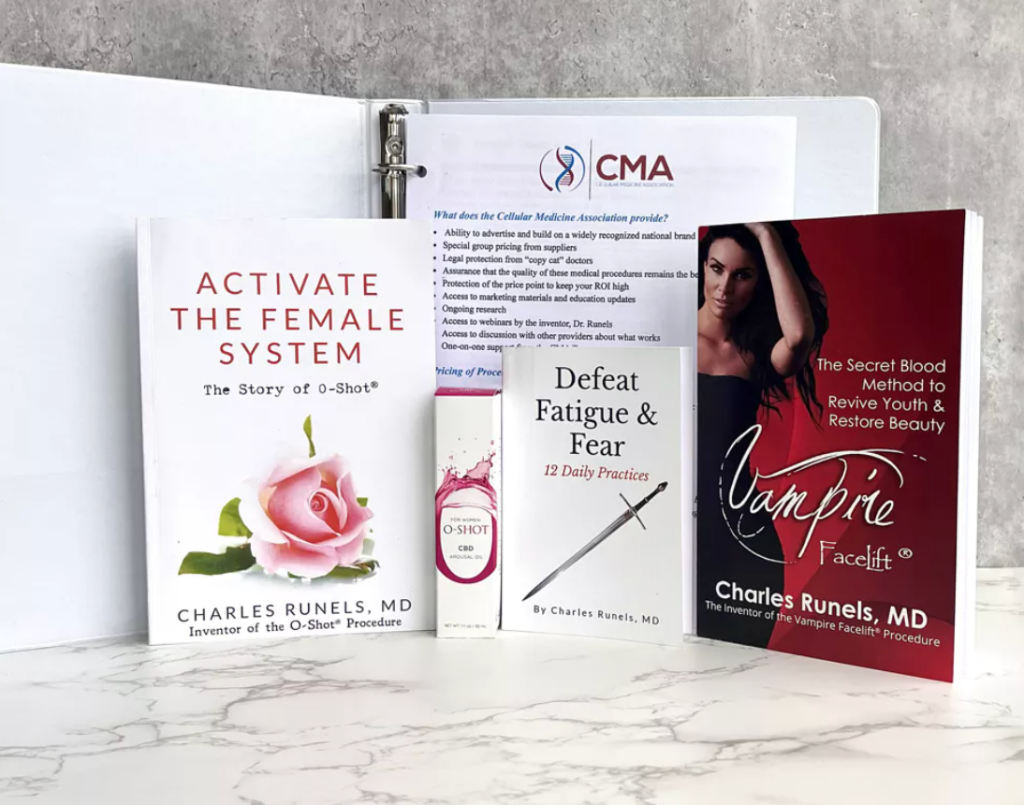
=>Benefits of the Cellular Medicine Association<=
=>Next Hands-On Workshops with Live Models<=
Notes
[1] Brinks et al., “Additive Effects of Platelet-Rich Plasma and Systemic Therapies in Androgenetic Alopecia.”
[2] Satoh et al., “A Case of Acute Myocardial Infarction Associated with Topical Use of Minoxidil (RiUP) for Treatment of Baldness.”; Aktas, “Could Topical Minoxidil Cause Non-Arteritic Anterior Ischemic Optic Neuropathy?”
[3] Santhiya et al., “Efficacy of Platelet-Rich Plasma in the Management of Oral Potentially Malignant Disorders – A Systematic Review.”
[4] Tedesco et al., “Regenerative Therapies in Lichen Sclerosus Genitalis Patients and Possible Efficacy in Preventing Squamous Cell Carcinoma Development.”
[5] Eichler et al., “Platelet-Rich Plasma (PRP) in Oncological Patients.”
[6] Wendland et al., “From Donation to Innovation.”
[7] Beitzel et al., “US Definitions, Current Use, and FDA Stance on Use of Platelet-Rich Plasma in Sports Medicine.”
[8] Furlan et al., “Testosterone Therapy for Female Sexual Dysfunction.”
[9] “‘Off-Label’ and Investigational Use Of Marketed Drugs, Biologics, and Medical Devices Guidance for Institutional Review Boards and Clinical Investigators”; David C. Radley et al., “Off-Label Prescribing Among Office-Based Physicians”; Van Norman, “Off-Label Use vs Off-Label Marketing of Drugs.”
[10] Planck and Laue, Scientific Autobiography and Other Papers.
[11] Thernstrom, “The Billionaires’ Vagina Club.”
[12] Runels et al., “A Pilot Study of the Effect of Localized Injections of Autologous Platelet Rich Plasma (PRP) for the Treatment of Female Sexual Dysfunction.”
References
Aktas, Habibullah. “Could Topical Minoxidil Cause Non-Arteritic Anterior Ischemic Optic Neuropathy?” JOURNAL OF CLINICAL AND DIAGNOSTIC RESEARCH, ahead of print, 2016. https://doi.org/10.7860/JCDR/2016/19679.8250.
Beitzel, Knut, Donald Allen, John Apostolakos, et al. “US Definitions, Current Use, and FDA Stance on Use of Platelet-Rich Plasma in Sports Medicine.” The Journal of Knee Surgery 28, no. 1 (2015): 29–34. https://doi.org/10.1055/s-0034-1390030.
Brinks, Anna L., Carli Needle Lawrence, Derek Maas, et al. “Additive Effects of Platelet-Rich Plasma and Systemic Therapies in Androgenetic Alopecia: A Retrospective Study.” Skin Appendage Disorders, May 8, 2026, 1–4. https://doi.org/10.1159/000552428.
David C. Radley, Stan N. Finkelstein, and Randall S. Stafford. “Off-Label Prescribing Among Office-Based Physicians.” Archives of Internal Medicine 166, no. 9 (2006): 1021. https://doi.org/10.1001/archinte.166.9.1021.
Eichler, Christian, Jens Üner, Fabinshy Thangarajah, et al. “Platelet-Rich Plasma (PRP) in Oncological Patients: Long-Term Oncological Outcome Analysis of the Treatment of Subcutaneous Venous Access Device Scars in 89 Breast Cancer Patients.” Archives of Gynecology and Obstetrics, ahead of print, April 4, 2022. https://doi.org/10.1007/s00404-022-06416-4.
Furlan, Vada A., Muhammed A. M. Hammad, Sophia Quesada, Sabrina Nguyen, and Jessica Yih. “Testosterone Therapy for Female Sexual Dysfunction: A Systematic Review of the Literature Demonstrating Outcomes in Premenopausal and Postmenopausal Women.” The Journal of Sexual Medicine 23, no. 8 (2026): qdag206. https://doi.org/10.1093/jsxmed/qdag206.
“‘Off-Label’ and Investigational Use Of Marketed Drugs, Biologics, and Medical Devices Guidance for Institutional Review Boards and Clinical Investigators.” January 1998. https://www.fda.gov/regulatory-information/search-fda-guidance-documents/label-and-investigational-use-marketed-drugs-biologics-and-medical-devices.
Planck, Max, and Max von Laue. Scientific Autobiography and Other Papers. Translated by Frank Gaynor. Philosophical Library, 1949.
Runels, Charles, Hugh Melnick, Ernst Debourbon, and Lisbeth Roy. “A Pilot Study of the Effect of Localized Injections of Autologous Platelet Rich Plasma (PRP) for the Treatment of Female Sexual Dysfunction.” Journal of Women’s Health Care 03, no. 04 (2014). https://doi.org/10.4172/2167-0420.1000169.
Santhiya, K., M. Kavitha, D. Pavithra, Mallolu A. Sanjana, B. Niveditha, and A. I. Samu Fathima. “Efficacy of Platelet-Rich Plasma in the Management of Oral Potentially Malignant Disorders – A Systematic Review.” Indian Journal of Dental Research, ahead of print, July 8, 2026. https://doi.org/10.4103/ijdr.ijdr_855_25.
Satoh, Hiroshi, Shuji Morikawa, Chifuyu Fujiwara, Hajime Terada, Akihiko Uehara, and Ryuzo Ohno. “A Case of Acute Myocardial Infarction Associated with Topical Use of Minoxidil (RiUP) for Treatment of Baldness.” Japanese Heart Journal 41, no. 4 (2000): 519–23. https://doi.org/10.1536/jhj.41.519.
Tedesco, Marinella, Barbara Bellei, Lavinia Alei, et al. “Regenerative Therapies in Lichen Sclerosus Genitalis Patients and Possible Efficacy in Preventing Squamous Cell Carcinoma Development: A Long-Term Follow-up Pilot Study.” Dermatology Reports, ahead of print, November 27, 2024. https://doi.org/10.4081/dr.2024.10079.
Thernstrom, Melanie. “The Billionaires’ Vagina Club.” Brave New World Dept. The New Yorker, June 29, 2026. https://www.newyorker.com/magazine/2026/07/06/the-billionaires-vagina-club.
Van Norman, Gail A. “Off-Label Use vs Off-Label Marketing of Drugs.” JACC: Basic to Translational Science 8, no. 2 (2023): 224–33. https://doi.org/10.1016/j.jacbts.2022.12.011.
Wendland, Kerstin, Kathleen Selleng, and Konstanze Aurich. “From Donation to Innovation: New Blood-Derived Products.” Transfusion Medicine and Hemotherapy, May 21, 2026, 1–14. https://doi.org/10.1159/000552492.
Tags
PRP, platelet-rich plasma, androgenetic alopecia, hair loss, minoxidil, spironolactone, combination therapy, atrial fibrillation, Dr. Shapiro, growth hormone, acromegaly, cancer recurrence, skin cancer, basal cell carcinoma, oral potentially malignant disorders, OPMD, lichen planus, lichen sclerosus, clobetasol, squamous cell carcinoma, vulvectomy, O-Shot®, Vampire Breast Lift®, breast cancer prevention, regenerative medicine, autologous therapy, FDA off-label, IRB studies, testosterone for women, hormone replacement therapy, menopause, sexual medicine, Clitoxin®, concierge medicine, The New Yorker, Billionaire’s Vagina Club, association vs causation, sexual function as a vital sign, birth control pills, ovarian suppression, physician marketing, patient education, research-based marketing, celebrity endorsement, Cellular Medicine Association
Helpful Links
=> Next Hands-On Workshops with Live Models <=
=>Next Hands-On Training with Live Models with Dr. Runels (includes marketing)<=
=>Hands On Botulinum Toxin Workshop That Teaches Medical & Cosmetic Uses<=
=> Dr. Runels Online Botulinum Blastoff Course <=
=> The Cellular Medicine Association (who we are) <=
=> Apply for Online Training for Multiple PRP Procedures <=
=> FSFI Online Administrator and Calculator <=
=> 5-Notes Expert System for Doctors <=
=> Help with Logging into Membership Websites <=
=> The software I use to send emails: ONTRAPORT (free trial) <=

[…] Training with Dr. Runels […]