
|
Journal Club with Pearls & Marketing 2026.02.03 Cellular Medicine Association |
JCPM2026.02.03
Transcript
The following is an edited transcript of the Journal Club with Pearls & Marketing (JCPM) of February 3, 2026, with Drs. Charles Runels and Xan Simonson
>-> The PDF of this live journal club can be read here <-<
Topics Covered
- The Explosion of PRP Research—and Why It Matters
- From Biology Teacher to Regenerative Physician: A Nonlinear Path That Works
- The Problem Most Papers Miss: Protocol Matters
- Who Gets to Practice? The Quiet Evolution of Medical Authority
- Building a Practice Around Regeneration, Not Just Treatment
- Joint Therapy: What Actually Makes PRP Work Better
- Beyond PRP Alone: The Role of Peptides and Biology Optimization
- Nebulized PRP: Experimental or Emerging Standard?
- Seeing Better, Healing Faster: PRP in Ophthalmology
- Experience vs Equipment: Mastering PRP Preparation
- Peyronie’s Disease: What the Literature Says vs What Actually Works
- The Missing Pieces: Supplements, Hormones, and Systemic Health
- Combining Structure and Regeneration: PRP + Fillers
- Safety in Aesthetic Regeneration: Lessons That Cannot Be Ignored
- From “Does It Work?” to “How Do We Use It Best?”
- Protecting the Brain: Lifestyle, PRP, and the Biology of Aging
- Final Reflections: Community, Data, and the Future of Medicine
- Opportunities, Training, and Next Steps

Charles Runels, MD
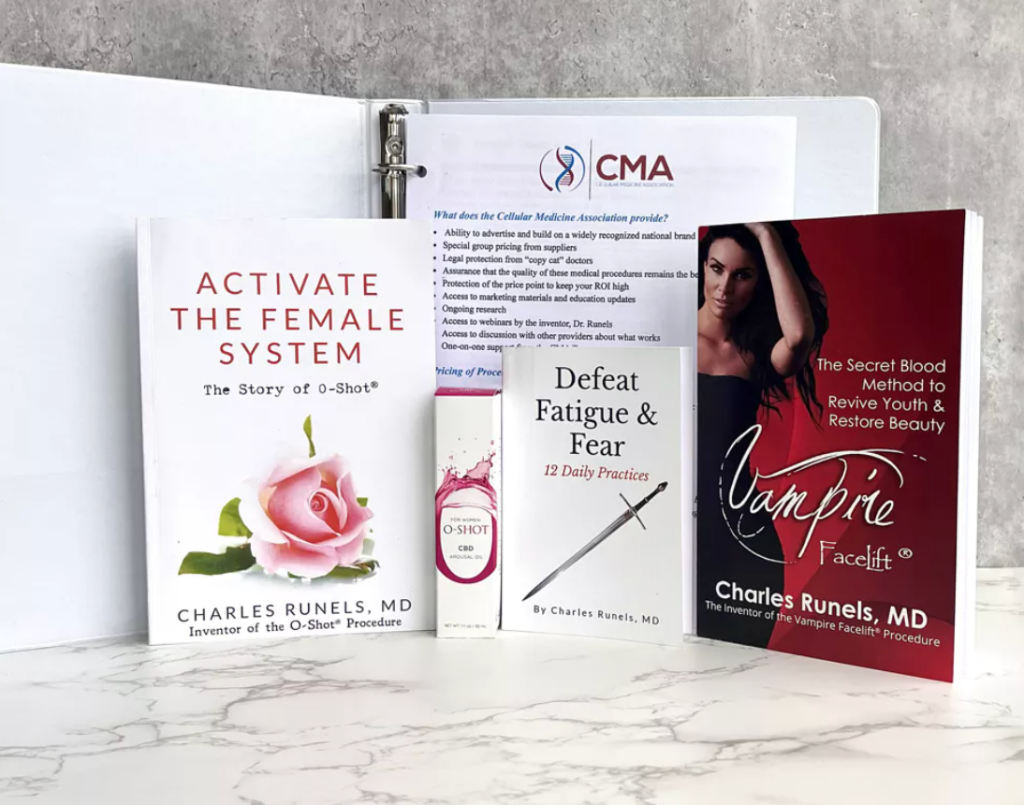
Author, researcher, and inventor of the Vampire Facelift®, Orchid Shot® (O-Shot®), Priapus Shot® (P-Shot®), Priapus Toxin®, Vampire Breast Lift®, and Vampire Wing Lift®, & Clitoxin® procedures.
Transcript
Charles Runels:
Welcome to our journal club. We have a very special guest today, Dr. Xan Simonson, who has been in our group for quite a while, so she’s got plenty of experience with our procedures and a very successful practice. So welcome, Xan. Say hello.

Hello, everyone. I’m happy to be here with you.
Charles Runels:
The Explosion of PRP Research—and Why It Matters
It seems that we have so much research coming out, and actually, one of the papers this week commented on the explosion of research. When I first picked up platelet-rich plasma in 2010, you could go to PubMed; if you typed that into the search bar, you’d get almost 3,000 papers. That was it. And then it’s exploded now, and every week I’m having more difficulty choosing the best papers because there are so many to choose from.
But we have papers today on using nebulized platelet-rich plasma for a lung lesion, a really good paper on lifestyle strategies to help prevent neurodegeneration, which I know is of interest to you, Xan, and another paper on the combination of fillers and PRP. And then we have some marketing ideas.
But before we get into some of the research, maybe tell the people on the call some of your history, Xan, so they’ll just kind of know where you’re coming from, just more about your practice, about your practice, and when you introduced platelet-rich plasma, just five minutes or so about your story. And then we’ll plunge in, and we’ll discuss the research, the two of us and anybody else on the call. If you’re on the call and you decide you want to jump in, just push the button to raise your hand, and I’m happy to include you in the discussion.
Xan Simonson:
From Biology Teacher to Regenerative Physician: A Nonlinear Path That Works
All right. I became a doctor later in life. So my history is I was a biology-biochemistry major and started out with spirulina research, and then I taught biology, AP Biology, genetics, for 27 years, and then worked on my PhD in admin, administration. And then I didn’t like it, so I retired early and went to med school.
So I graduated in 2015 and was lucky enough to get residency in an internist’s office, a couple of them in the MD’s office. So I learned how they think. So for those, I’m a naturopathic physician, so we do everything the MDs do, but we also have a bigger toolbox for homeopathy, botanical medicine, regenerative medicine, and nutrition. IVs are more emphasized in our studies.
And then I opened up Xan Medical Clinic in 2018, and about the same time, I was introduced to Dr. Runels, so I did the training. So I was lucky when I was in training; I thought I would work with teenagers, since that’s where I’d worked most of my life. But meeting somebody, as you say, by chance when we got our computers fixed, I met Dr. Vance Inouye, who is a mentor of mine, and he ensured that I got on all his shifts. So I learned to do the regenerative medicines, the prolotherapy, the PRP, very early on in my clinical studies. And then I also did a residency with him. And then I learned all the Vampire procedures. So I’ve been doing this since 2018.
And then most recently, during COVID, I started mentoring people, folks, MDs, NPs from around the nation. I have two new docs I’ve trained in my office. We have a full office. You walk in, you can go to Xan Medical Fitness. So we have our patients doing rehab there, getting personalized fitness because I want everybody to be working out. We have a myofascial massage therapist. Then on the other side, we have all the aesthetics, primary care, and regenerative medicine on the clinic side.
Charles Runels:
The Problem Most Papers Miss: Protocol Matters
Beautiful. Just to catch, for those of you who are new to the group and how we think about our group, one of the weaknesses that’s pointed out in almost every paper, and again, one of the papers today we’ll talk about, is that there’s no standard protocol. JAMA published a paper about PRP for erectile dysfunction, and they said there is no standardized protocol, and they included some of the people in our group who listed the P-Shot®. And so we persuaded them, with an attorney and about two months of pressure, to correct that article.[1],[2] And you can find it, if you look around in JAMA, I’ll put the link in the email that goes out.
And because we do have a protocol, and we have right at 3,000 doctors participating in that protocol and almost now two decades’ history of safety. And over the years, imagine you’re the guy that first put a PRP in a penis, as best I can tell, and then trying to roll that out as the research grew, deciding who should be participating and who not. And starting in, if you remember back in 2000… Just so you know how we think about our group, back in around 2006, doctors went to jail and lost their licenses for writing prescriptions without seeing a doctor. Think about that. They went to jail and they lost their license for what is now commonly done.
Just like the guy who first came out with liposuction, he lost his license. It’s cliché, the first people usually to do something, they get in trouble for it. And I remember someone offering me a job that paid a lot of zeros amount of money for writing prescriptions for Viagra in the early days of Viagra and internet. And I said, “No, I don’t want to go to jail.” And people did. And now you can go on Amazon and for $25, you can get a visit by text message. No one even looks at you, or you can get a visit for $45 for video with a prescription and prescription drugs shipped to you from Amazon.
Who Gets to Practice? The Quiet Evolution of Medical Authority
So the things are, who’s a real doctor has been all over the map. I’ve always liked naturopathic physicians and the first hands-on course, the way they think, you included, of course, Xan, but the way they think. But if you look at their license, they practice like, correct me if I’m wrong, Xan, but they practice equivalent to an internist in, is it three states? Arizona, Washington? Did I get that wrong?
Xan Simonson:
No, we have 18 states, almost 18, that have licensing now. I think there’s a little bit more, 20, but ones that can write scripts and practice like a primary care.
Charles Runels:
Yes. So you now have 27 states where a nurse practitioner can practice without physician supervision.. And so in the beginning, the first class I taught, I allowed, it seemed to make sense to me, it’s actually more in line with the philosophy of a naturopathic physician than most of your colleagues in internal medicine who are still wondering what PRP even is. Couldn’t give you a good explanation. And so we embrace that license.
And when it comes to nurse practitioners and RNs, from the beginning, we actually had the RN societies calling us for the CMA to tell them what the rules should be. And to play it safe, the rules we made were, and they were adopted, as far as I know, by every state: whatever your licensing philosophy and policies are regarding the injection of fillers, that should be the minimum requirements for the license to inject platelet-rich plasma. And I still think they’re (HA fillers) much more dangerous than PRP. You can’t cause blindness and skin necrosis by injecting PRP in the face, but you certainly can with an HA filler.

And in one study of HAs to treat urinary incontinence in women, two out of 82 women got a urinary obstruction so severe they had to have surgery to fix it. And there is still an FDA-approved material using Coaptite, which you would never put in the mouth, and that has shown granuloma sufficient to cause urinary obstruction requiring surgery. That has never happened with PRP, and we’re now pushing to get decades of doing this procedure.
So we’re making it up, often happens in medicine, happens with lasers, what’s the safest way to get the best effect, and what should be the licensing requirements? So the CMA has… That’s been our policy. We still, of course, require… We check licensing. We have full-time staff that checks licensing. And some of our absolutely most amazing providers are naturopathic physicians, and Dr. Simonson is one of them.
So thank you for being on the call, and I think you heard that background is pretty amazing, and I’m eager to get your perspective. I’m going to use these papers as a jumping-off point. Oh, tell me a little bit more about where you are. And I know you teach classes as well for our physicians. We’ve been doing them for eight years and successfully both clinically and medically. So tell us a little about where you are, and before we get into the papers, how they can reach you if they want to come to one of your classes.
Xan Simonson:
Building a Practice Around Regeneration, Not Just Treatment
I’m in Tempe, Arizona is where the clinic is, lived in the little town next over, Mesa, since 1986. So we’ve done classes; we just officially started the Vampire classes in December and January. We’ve already had two full classes. And then before that, I’ve been teaching a lot of MSK since 2016, actually was the first class for how to do prolotherapy joint injections using… if there’s a joint, if there’s prolo or PRP, or people come in with pain, that’s where my passion lies, is helping people not to have surgery.
And when I learned, and I was quiet, I have to say, because Charles, you weren’t letting naturopaths in for a while, so I never gave up my membership. I kept it. I’ve learned so much as I grew as a doctor with all the research, and that’s my gig. Since I come from the biotech world, I’ve built the biotechnology program and research. And so my day starts every day off reading research for about an hour, sharing it with my new docs or those I mentor.
But I learned when I went to learn your procedures, it was because I was seeing so many of my older ladies with UTIs and stress incontinence. That’s what drove me to learn the procedure. So I came back and I did an 82-year-old, was one of my first, and then she went and told all her church friends. And so I really learned how to do the O-Shot® on the older ladies and became well, so I’ve done hundreds and hundreds. What I did discover early on is that I do that procedure, they buy a two-for-one because they come back in three months, we repeat it, and then from then on out, they’re rejuvenated and I can do it yearly or 15 months. But my oldest patient now is 94, so she’s been with me since 2018 getting them.
Charles Runels:
Wonderful.
Xan Simonson:
Yes.
Charles Runels:
That’s wonderful.
Xan Simonson:
So you can go to XNMconsult.com, XNM, like X is Xan, N, and then M for Maileen-
Charles Runels:
XNM.
Xan Simonson:
… consult. Yeah. XNMconsult.com is the new website. Or you can reach me at D-R, and my first name is Xan, X-A-N, last name is Simonson, S-I-M-O-N-S-O-N, @Gmail.com. So if any of you have questions or inquiries, you can shoot me an email, I’d be more than happy to respond. And then we get our new classes up. I could share that as well.
Charles Runels:
Okay, beautiful. I’m going to put that into the chat box.
Xan Simonson:
I think we’re going to have an IV class in May because everybody’s been asking for IV therapy.
Charles Runels:
X, N as in Nancy, M as in medical.com.
Xan Simonson:
So it’s XNMconsult, C-O-N-S-U-L-T.
Charles Runels:
Okay. Consult.
Xan Simonson:
.com.
Charles Runels:
Got it. Okay. I’ll put this in the chat box. You know what? It keeps forwarding me to something different. I don’t know what’s happening, but I won’t keep wasting time. I’ll put it in the email that goes out and-
Xan Simonson:
Yeah, put it in-
Charles Runels:
Well, I’ll make sure they have a good link to it. So let’s go back to the… let’s see. Let me get the full research pulled up for everybody. And this is good because you’ve got all the experience with joints and hundreds of O-Shots®, and we’ve got papers about all that.
Joint Therapy: What Actually Makes PRP Work Better
So this first paper is about right up your specialty. They did a paper looking at three arms.[3] They looked at saline in the joint versus a single spin versus a double spin for knee pain/osteoarthritis. And they showed benefit in all three arms, which is something that I think a lot of people forget, is that actually saline does have positive results. And they showed similar benefit for single spin versus double spin, but the double spin seemed to show benefit that lasted longer.
By the way, I’m going to give you guys all these references before I hang up. I’ll put this in the chat box. Do you have any comments on this, Xan? Because I know you’ve done a lot of joints.
Xan Simonson:
I’ve done… Oh, doing the double spin?
Charles Runels:
This one is about double spin versus single spin versus saline, and they all showed benefit, but single spin and double spin were similar, except double spin seemed to last a little bit longer.
Xan Simonson:
What I have found clinically through the studies is that it really depends on the age of the patient and the degradation of that joint. Many of the joints, if they’re just beginning, you can get away with a single spin. But if it’s pretty advanced or moderate, the double spin can give you a little extra of those growth factors and cytokines and VEGF. And I found it to be just as comparable, when you do a good double spin, have a good system, to be almost as good as some of the exosomes that they offer out there, which are way more expensive.
Now, that’s clinically. And I mix everything, though, Charles, so mine might be skewed because I do a lot of peptides. So BPC and thymosin beta-4 are big in my practice as far as combining that with PRP. So when I would used to have to do it once every four to six weeks, three months, now can go out several months when you combine the peptide with the PRP.
Charles Runels:
Yeah, we had a paper we went over yesterday, one of many we’ve done in the past six months or so, about all the different encompassing things you can do to help PRP be more effective. And it’s, as you would expect, things that make the health better and decrease inflammation
Charles Runels:
… and nutrition, but the peptides are definitely a new thing that for the past year or two that people are doing more and more and patients are asking for more and more. So tell us again which ones you prefer when you’re treating the joint, because-
Xan Simonson:
Beyond PRP Alone: The Role of Peptides and Biology Optimization
When I’m doing the joint, I’ll use BPC-157 and Thymosin Beta-4. There’s several thymosins out there, but Thymosin Beta-4. Now with the FDA and stuff, those of you that may or may not be into peptides, BPC can also be found as PDA, like pentadecapeptide. They’re identical. It’s just different names that they’re using so they can sell it without the FDA monitoring it so much because it’s not on the Category 2 list.
Charles Runels:
Yeah, that’s a good point. I was at a conference this past weekend and had a prelude of what might be coming from someone in the know, but the current administration, as most of you know, is becoming more lenient about leaning towards things other than pharmaceutical solutions or in addition to pharmaceutical solutions, and then of course you have the states like Florida, where they are making state laws that are more inclusive of regenerative therapies, but hopefully, with the current administration, it will dodge fewer bullets. The big thing I think is that, not to make claims, you talk about what the research is, Kim calls neovascularization and then pre-circulation, but it’s not you’re going to make arthritis go away, being careful with your claims. You want to comment on that idea about-
Xan Simonson:
Right. Yeah, not making claims. I think it can only make it better. Especially being a naturopath, we’ve got to look at their lifestyle, what they’re putting in their mouths, what deficiencies they have. All of that is going to help obviously with the healing and the peptides, but what I counsel with all the time, Charles, is if you’re going to use peptides is to get them from a compounding pharmacy. Do not buy research-grade. That’s where you’ll find yourself in trouble because a lot of the folks come in, they sell you a medical device and they go, “Oh, by the way, I have peptides,” and they’re clinic-based, meaning they’re not prescription-specific, patient-specific. That’s a big no-no.
What you have to know is that the peptides in the research, and since I come from the research world, and it clearly says on the bottle “Not for human use or research,” they don’t have to remove the excipients like the tetrafluoroacetic acid, the TFAs, and that is carcinogenic and can cause the anaphylactic shocks that happened at one of the conferences not last fall. From a compounding pharmacy, you’re assured that they’ve removed those exotoxins, especially like the TFAs. That’s why you’re paying a little bit more. A lot of the bio-influencers and bio-hackers will come down on compounding pharmacies, but they’re doing their due diligence to make sure that you’re getting a pure product for human use.
Charles Runels:
That’s a very good point in that the conference that I just attended, Karen Rea’s Regen Conference down in Clearwater, there was a presentation that talked about exactly that problem and he had a case report where someone was very ill from the same sort of mistake being made.
Nebulized PRP: Experimental or Emerging Standard?
Well, let me jump over to this case. This is just a real quick note. This person, it’s a case report where someone had pulmonary consolidation cavitation, this was after cancer, and they nebulized with a pressure nebulizer, not heat, autologous PRP, and send us some pretty pictures to show how… Look at that.[4] It’s amazing. So nebulized drug delivery has been done, and I actually did it when I had COVID. Just nebulized PRP. I never got pneumonia, I don’t think, but I was pretty sick first time around. It’s something that, I’ve heard it talked about for at least the past decade. I know there’s one radiologist and a couple of pulmonologists in our group that have talked about using it. So there you go. I don’t know that it’s ready for primetime. Have you been using it?
Xan Simonson:
Oh, it works great. I’ve done hundreds of PRP.
Charles Runels:
Wonderful. Tell me when you use it and how you’re doing it.
Xan Simonson:
If they come in with any sort of, well, COVID, I did a whole lot. We put them outside, though, because you have the virus and stuff. They would breathe out. They each had their own, provided their nebulizing machine, and then we would have them follow it with the PRP, follow it with something like glutathione or acetylcysteine, the NAC, and their recovery was remarkable. I’ve used it in small children, too. I had a severe asthmatic three-year-old and we did just two or three treatments with that, and it actually improved his asthma where it was stable.
Charles Runels:
Beautiful. Have you treated anyone… I have a particular hatred of emphysema. I lost my maternal grandfather to emphysema. Pulmonary rehab, as you know, does nothing to actually make the lung healthier. It just increases VO2 max, but it doesn’t help the lung recover. Have you treated emphysema? Someone needs to do that study.
Xan Simonson:
I haven’t done a study, but yes, I’ve treated someone with emphysema, and also I’ve done quite a few with where they have fibrosis coming on in their chest and they were told then there was no cure or nothing to offer in the traditional world. We did that and it helped open up their lungs, and then you’re following that with some proteolytic enzymes. The enzymes help break down that scar tissue, and their lung capacity increased, so…
Charles Runels:
So you measured pulmonary function as well when you did it?
Xan Simonson:
Yes.
Charles Runels:
I’m so happy you did that. We need to write that up. Did you measure pulmonary function?
Xan Simonson:
I did, but we could do that starting. I could be way more cognizant of it, that we’re doing it, and measure their lung function because-
Charles Runels:
Yeah, all we need is a kit with a little pilot-
Xan Simonson:
That’s [inaudible 00:22:33] that at least I’ve been through any of the trainings I’ve done will nebulize PRP.
Charles Runels:
Yeah, so if you have a diagnosis of emphysema, as you know, you can graph it out, you’re going to lose this amount of lung function per year, and then you die. And there’s nothing we can do to help the lung degradation stop or reverse. We can just help your VO2 max stay better so you can deal with your decreasing ability to breathe. If we did a little pilot study where you just did this to 20 people with emphysema and document improvement and pulmonary function testing, that could be the-
Xan Simonson:
That’d be cool.
Charles Runels:
… start of something really important. I’m glad to hear you’ve been doing it. I’ve never treated emphysema with it, just a few people with COVID.
Okay, let’s see. Tell me more about the outside thing, because you can’t actually obviously be nebulizing everybody’s PRP in the middle of the office.
Xan Simonson:
Well, we have [inaudible 00:23:31] clinic-
Charles Runels:
[inaudible 00:23:31] patio? Go ahead.
Xan Simonson:
Yeah, have a patio that opens up with the seats out there.
Charles Runels:
Beautiful.
Xan Simonson:
We would just put them when they’re doing PRP out there. That was during-
Charles Runels:
I love it.
Xan Simonson:
… COVID. And then of course we would make enough for them to take home and continue at home for them to do it.
Charles Runels:
Seeing Better, Healing Faster: PRP in Ophthalmology
Wonderful. This is just to mention, I just had cataract surgery.
Xan Simonson:
Oh, my God.
Charles Runels:
I spent seven years as a lifeguard out in the Alabama sun. I had blue eyes from my mom. I’d be out in the sun and get black every summer. And then, I also had acne and was treated. Back in the ’70s, they would treat acne with x-ray therapy, which gives me a 25% chance of thyroid cancer, and basal cells started coming up at 40, which you would expect, and early cataracts, thank you very much. When I have people suspicious of the MD world, you can see why I also have a very jaundiced cataract eye when doctors tell me, “This won’t hurt you.” Obviously I’m an MD and I think drugs save lives, but even though I’m… you can say that you and I and everybody on this call is on the edge of growing research about something new, I also am very quick to look for things that are not true, that just don’t make sense.
For example, went back in, I guess it was around 2000, something like that, 26 years ago, maybe 2001, someone walked into my office and said, “We’ve got this new pain medicine.” See if you can guess what it was. “We got this new pain medicine. Because it’s a slow onset, even though it’s like morphine, nobody’s going to get addicted to it.” What’s the drug? Right? Then later, 20 years later, you got everybody dying from OxyContin and addicted like hell to it, and lawsuits. When the drug rep told me that, I’d worked in a rehab center, I said, “Well, shit,” and literally told them to leave my office because it didn’t make sense. But there was a lot of money spent and a lot of good-looking drug reps went around and told doctor that lie, and a lot of doctors believed it. Not that I’m smarter, but in some ways it was good for me that I had x-ray therapy for acne because I am very slow to believe things, which seems counterintuitive, right, to the guy that’s the innovator, but I am.
Anyway, because of that, I had cataracts that are really bad cataracts that I got fixed, and now I can see even better than I have maybe in 40 years, and I wish I would’ve known this. There’s lots of papers we’ve looked at regarding PRP drops for dry eyes, and it definitely works.[5],[6] There’s probably a dozen papers out there about it, but this is the first one I’ve seen where using PRP at the time of surgery helped healing and made the outcome better. All of us are dealing with people that are having cataract surgery. When I talk with my ophthalmologist about it, he’s an excellent, well-known guy, he had PRP capabilities in his office, but we just talked about the dry eye part and we didn’t even consider putting them in my eyes post-op. Have you done this at all for dry eye or have you used the-
Xan Simonson:
I use it a lot for dry eye, and actually, because I was a lifeguard, too, for many years, and I burned my eyes when I was younger, but it’s probably led to it, but I was diagnosed a few years ago with the keratoconus, especially really bad in my left eye. Before I had surgery, I started using PRP, and then right after, I didn’t use their medicine, I was using PRP drops. When I went in, they were going to fit me for the lenses, that they said I’d have these sclera lenses, and I didn’t qualify afterwards.
Charles Runels:
Oh, wow. So it worked out well.
Xan Simonson:
And all I did was use, well, BPC-157 eyedrops and PRP.
Charles Runels:
Beautiful. Fill us in on… Are you guys catching how experienced Xan is? Again, thank you for about every… you’ve had experience with every paper we brought up, and I love it.
Xan Simonson:
I was like, “Oh, I already do this.”
Charles Runels:
Experience vs Equipment: Mastering PRP Preparation
Tell me about how you’re making your PRP. You probably have more than one way.
Xan Simonson:
I have more than one way, depends on what… Because I came from the biotech world, so I have a nice hood and stuff, so I can make the PRP using sterile conical tubes and then decide on my concentration, but that’s very advanced. My kit-wise, I use something very similar to the RegenKit if I want one spin, or I’ll use the CAREstream, which I was a… I’m like you. Especially when they come in with new devices and stuff, I’m like, “Yeah,” but I’ve been very, very clear since I came in October, I just got it when I was seeing you, Charles, is the CAREstream PRP, which is a three-minute spin, and then I can choose how concentrated I want to make it or not. It has been a very nice addition to my practice as far as saving time and making the PRP.
Charles Runels:
It’s called Care Span?
Xan Simonson:
CAREstream.
Charles Runels:
So you can make it like double-spin-
Xan Simonson:
I can hook you up with Steven Marquez. He’s actually been wanting to talk to you.
Charles Runels:
Yeah, give him my cellphone and I’ll introduce-
Xan Simonson:
I know. I just didn’t want to give him your cellphone, but he’s worth having it. It’s collecting dust, I have the Insight or I have a PureSpin. I have three or four centrifuges. I used them every day in my, I call it, my previous doc life, biotech. This CAREstream has quickly become very important in the practice because of the time-saving and how I can manipulate it. They’re very inflamed, so I don’t want to make it too much, or, hey, they’re young, they’re an athlete, I need to give them a super-concentrated. So I can do that with the CAREstream.
Charles Runels:
Beautiful. Yeah, I’ll have to look at it and I’ll bring it back to the group. Thank you for the tip.
Peyronie’s Disease: What the Literature Says vs What Actually Works
Okay, so this one is really interesting because there’s a lot between the lines. It’s another Peyronie’s disease study.[7] If you look at what’s happening, they go, we all know, we’ve all treated, if you’ve been in the group more than a few months and you do the P-Shot®, you’ve seen this work. We’ve all had great experience with doing the P-Shot® for Peyronie’s disease. The first paper I saw come out about it, we were already doing it, the first paper I saw coming out about it, they actually mentioned it in here, it was by Dr. Ronald Virag, who’s a legend in the urology world.[8] He’s the one who came up with the idea for the injectable vasodilators like Trimix and Caverject. That was his idea.
He did a study showing where he did PRP and he used a regen kit that has an HA, that comes with it as an activator, that I think has finally become FDA-approved, but this was maybe seven or eight years ago was available in the US, and it comes in the kit. So it’s not like a Juvederm with the cross thing. It’s an activator that, when you add the PRP to the single-spin tube, it’s already in there. Anyway, he did that once-a-week injections and he demonstrated dramatic improvement, and also improvement in erectile function.
If you look at this study, what they did was they infiltrated 12 milliliters intralesionally and perilesionally. I’m not sure exactly what they mean by that because, is that subdermally? Is that intercavernosally? But it was a non-erect penis. I’ve never seen detumescent in a paper before, but I love the word tumescent because you don’t really see it much except in the erection world. But it’s a good thing to have tumescence. Anyway, they got one per week for three weeks, and then they didn’t put anything else with it. No pumps, no anything else and, I don’t know why people do this,
Charles Runels:6
… Told them not to have sex for 24 hours. I tell people, “Go have sex when you get home if you want to.” But they told them not to have sex for a day. So they had an injection once a week for three weeks and then they waited four weeks after that course and studied the curvature and the erectile function scale. And then if you read, that’s actually pretty good stuff. The penile, you just look at the curves, their curvature gets better, their plaque gets smaller and their tumescence, they have better erections. So you think they’re going to have, “Oh, this is good stuff,” but then when they come down and start talking about it, they say, “Well, the change in the discussion…” They say, “The change in the curvature was not as much as has been documented in other studies.” On the other hand, their beginning curvature was not as much as other studies on the average so that you would expect it to not improve as much because you can’t get better than straight, right?
Just like when our study of female sexual distress with our O-Shot® procedure that we’re going to be publishing very soon, the women who have… That’s a grade where lower, it’s a better score. So think about this for a minute. If you’re over 11, you’re distressed. And so, if you’re at 25, you’re distressed or if you’re at 20 and you can drop it by 11 and come 21 down to 10 or 20 down… Anyway, you can drop it by 10 points. But if your distress is only three, you can’t get negative, so you can’t improve by 10 points. You might improve, but you can’t improve by 10 points if your score is only some small number because it’s graded zero to four. So in theory, you could have a score of zero. So in the same way the delta is going to be smaller if you have a less curvature, almost by definition, than if you have a mean curvature or even a… Anyway. So they acknowledge that weakness to their study.
The other thing, if you look at the timeframe, they went once a week for three weeks and then they waited four. So the total timeframe was only seven weeks, less than two months. And surprisingly, in our study of the O-Shot®, we’re still seeing dramatic improvements up to six months that are then sustained for a year. And just as you indicated, there is definitely an additive effect and often women will have improvement in their incontinence on the first one, and then their sex gets better on the second one, and then they’re often good to go for a year and a half. Anyway, so even in soft tissue studies of wounds, they don’t end the study at seven weeks. Full effect in soft tissue studies in wound care, as you know, is 12 weeks. So they ended the study at least a month sooner than would be reaching 80% of effectiveness.
And then they acknowledge that and other, and of course they didn’t use a pump, which is part of our protocol. And then when they get down to the conclusion, PRP injections were well tolerated, nobody’s ever documented any serious sequelae and yielded statistical significance at four weeks. However, the mean change was clinically meaningful in not only a minority. And this finding is further tempered by concerns about potential measurement errors and the mild baseline. Taken together with a heterogeneous literature, these findings support cautious optimism and keeping PRP investigational. In other words, we’re not supposed to be doing it yet.
This is the most biased-
Xan Simonson:
Paper.
Charles Runels:
Unwell thought out… I’m not going to go further than that. It’s just biased and not well-thought-out. But even stopping at seven weeks and using people with less curvature, it showed benefit, but by no way does it negate the other papers like the one with Virag who showed that PRP was better than Xiaflex. Now I definitely want your comments on this, Xan, but just one other statement. Xiaflex is usually a series of six or seven shots that cost over $20,000 if you had to pay for it. And there’s a risk of penile fracture, which means now you go from a curved pencil to a broken pencil and you get an implant. Not the end of the world, but not something you want to wish for at Christmas is something you get if you have to.
And there is no increase in erectile function. Or you can use stuff like alpha interferon and verapamil, which don’t really give such great results. You can use just a pump alone. In one study, the British Journal of Urology, 51% of the people who were in that study canceled their surgery. So you get 51% are happy with just a pump.[9] So we’ve been doing… Also, it can recur if you’re just injecting the lesion, which I think is a flaw in both Virag study in this study, depending on what they meant by injecting around the lesion. Because of its autoimmune nature, if you do surgery on Peyronie’s disease, you take out the plaque, you can cause of course fracture and erectile dysfunction and the penis gets smaller. But it’s also prone to recur because it’s autoimmune. It can recur somewhere else along the shaft.
Where I think what’s happening with our procedure… This part is speculation, everything I’ve said so far is straight from our research. This part is speculation. I think by injecting not just the plaque, but many of us just do a straight-up regular P-Shot® and you get all the way through the corpus cavernosum is infiltrated, then you use the pump along with that and the combination is just amazing. And that is not what they did. What they did was something much less than that. And I usually space out the repeat injection for Peyronie’s by 8-12 weeks so that you have at least close to full effect. Probably full effect is more like six months, but you get close to full effect before you repeat it if you wait eight weeks, which was one week longer than when they ended their study.
Now I’m through talking. I know that you’ve done this and you have some smart things to say too.
Xan Simonson:
I do. I do quite a bit of Peyronie’s. You do one and then they share I guess or was, but I do. I do your shot along with the pumping and we also offer the shockwave therapy, which we have found to be very successful. Those that can afford a home machine I found do recover much faster is all. But I’m like you, I don’t repeat it for three months. I think that if you do a good injection and stuff and they got the concentration they need that’s going to work for three months and also allow it to heal and then have them doing just the pumping and/or the shockwave. They do very well. I’m surprised that-
Charles Runels:
Thank you for reminding me of shockwave. It’s such an important part of the formula. And if you go to… I’m going to pull this up just so everyone knows where it is and what it looks like. You may have something similar on your website, Xan, but hold on just a minute.
Xan Simonson:
Oh, yeah, the little… I don’t know if I’ve put mine up, but yeah, we do a lot of shockwave.
Charles Runels:
The Missing Pieces: Supplements, Hormones, and Systemic Health
Let’s see, where is… Yeah, this one. This is something that everybody on the call can show their patients. If you go to priapusshot.com/Peyronie’s, I spent a week or two just pulling up the research regarding the treatment of Peyronie’s. And you can comment on this too, please. These are supplements that have strong research showing to helping with Peyronie’s. Actually vitamin E, that dosage if it’s done along with other therapies, CoQ10. C, I just added in there because I think Linus Pauling was right and I just think everybody [inaudible 00:40:22].
Xan Simonson:
Everybody needs it. I think the only thing that’s missing there is nitric oxide. I add that.
Charles Runels:
Yeah, thank you.
Xan Simonson:
Mine is nitric oxide.
Charles Runels:
Yes, thank you. That needs to be added. And then, of course, the pump and I have the link to the paper. And then the P-Shot®, I have a suggested protocol, but it could be modified and then I give up if… Maybe I should make this later on. I’m thinking we should give up at 14 weeks. This really ought to be pushed back to more like six months or something. But I’m acknowledging not everybody is going to get well. And maybe you do try collagenase and someone is eventually going to need, if you live long enough, probably need an implant. But it is associated with low testosterone. I think everybody should be checking prolactin level in men because you only find one or two a year. But when you find hyperprolactinemia, you change the [inaudible 00:41:22].
Xan Simonson:
I know a lot.
Charles Runels:
Yes, you find [inaudible 00:41:25].
Xan Simonson:
The only thing that it’s in 100% of my Peyronie’s though. So I don’t know if it’s just my guys here in Arizona, is the one I would add is vitamin D. They all have very-
Charles Runels:
Yes, thank you.
Xan Simonson:
Low and I bring up their vitamin D. We give them the shots and stuff and that just makes the healing so much easier and faster and they feel better. It’s amazing. That along with the hormones that they need.
Charles Runels:
So I need to add two things to this paper and I need to move that farther away. I did this by the way, about six years ago, so it’s definitely time for an update. And I don’t even have shockwave in here. Holy smoke. So that needs to be put in here because a lot of that research has come out in the past six years. And there is some studies that daily low dose Cialis, independent of its ability to improve erections, has something to do with the… I’ll go over the research on that paper… But it has something to do with the inflammatory response and it can help with Peyronie’s as well. And, of course, stopping smoking and walking is anti-inflammatory and helps as well. So thank you. If you see anything else I need to add to that, Xan, send me a link because this is-
Xan Simonson:
I will.
Charles Runels:
A lot of our-
Xan Simonson:
I’ll read the minute because kind of look at my seven… I took yours, and then of course I’m a naturopath, so I was like, “Hmm, we got to…” It was just what I saw. Vitamin D, vitamin low, low, low. Everybody comes in vitamin D, low, low, low. If their vitamin D is low, for those that are doing and you give them hormones, their hormones will never optimize if you don’t optimize their vitamin D. Because vitamin D, how I always explain it is, you have your body out there, you have your hormones, your enzymes, your cofactors, your vitamins. Vitamin D is, for this orchestra of all that, he’s the conductor. And-
Charles Runels:
That’s a good way to put it.
Xan Simonson:
Depending on where the level is, but I see it where the conductor may be on the stage, but his wand is nowhere near his hand. So you can have all this stuff, but if you don’t have a good vitamin D level, then they’re not going to work as well.
Charles Runels:
And that is, there’s so much research now backing that up, right? That’s not conjecture. That’s well-supported by so much research. And I love that you’re waking up every morning reading for an hour. That habit can change your life, can’t it?
Xan Simonson:
Yes.
Charles Runels:
Combining Structure and Regeneration: PRP + Fillers
I think you guys are understanding why I’m so happy to have Xan on the call. She’s so knowledgeable and experienced. So this one, I’ll tell you one of the lucky things that happened in my life. I don’t know that I’ve told this to a few people, but that come to my workshops. I’m not sure it said it on the recording, but I didn’t think of this idea of somehow doing an HA filler and then putting PRP on top of it and calling it the Vampire Facelift®. And one day that idea didn’t come to me. What happened was, the rep who sold me the first centrifuge said, “Use this like filler and you get new blood flow and volume. Never been a side effect.”
So I immediately thought, “That should go in my penis. That’s a great place for volume and blood flow, but I’ll do what he says and use it in the face.” And so I did it quote “like filler”. And if you go to the way back machine, I can show you that 2010 website where they had pictures of and nasal labial folds and such. So people came in and I used it the way I used Juvederm Ultra Plus, and they would come back, I brought them back at three weeks. That’s when it’s supposed to start to work. And many of them would say, “Yeah, my face is glowing.” They could see the neovascularization. “My family says my complexion looks prettier,” but the shape went away because really you can’t sculpt with it like you can an HA filler.
So then I would take out a Juvederm syringe and do what I knew how to do to make a beautiful shape. And then they all loved it because they had the neovascularization. And then I thought, “Well, why am I doing it in two steps? Let me do it all in the same day and I need a name to call it. Let’s call it the Vampire Facelift® where you do your best work with filler, put PRP on top of it.” Then the results were so amazing. I go to the research and I find where that technique was already being done in the wound care literature where you put on exposed bone and tendon, they put an HA down and then put PRP on top of it. And that layer cake, so to speak, caused the filler to act like a scaffolding. And then the PRP would recruit stem cells to the area and build on top of it, and you could re-epithelialize the exposed bone and tendon. And research shows that it works better with that HA.
And then, but this is the first paper I’ve seen where they’re now saying, “Yeah, it’s a good thing to do to combine the two. And when you’re using fillers combined with PRP, you’re going to get a great result.” So I think there’s going to be more explosion of how to do that. And normally I don’t usually combine the two in the same syringe because then it loses its viscosity. It can’t shape with it. So I’ll use the filler to create the shape and the PRP on top of it to make the upholstery metaphorically, unless I’m filling in a space instead of sculpting like the labia majora or a big loss of volume scar.
So I’m through rambling about it, but I was so excited about this paper talking about those ideas. Talk to me about what your ideas about that are, Xan. And then we’ve got three more papers, and we’ll be done by 3:00.
Xan Simonson:
So before fillers, they’re so scary actually, right, if you don’t… So I’ve become more aptitude with it since I learned your method and I stay in my lane there. But I very much was using the PRP then become the PRP filler, the bio fillers and stuff, because it can’t hurt and it will only go away. So I think you’re going to see, you were talking earlier more on the… I have way more women coming in and asking about PRF, asking more for the bio fillers instead of the synthetic ones. And so I think that you’re going to see that evolve where you can do the same and it gives them volume. And my women love it. And men.
Charles Runels:
So that’s a good point. So using the PRF. Let me just make a note to the group though that-
Xan Simonson:
[inaudible 00:47:51].
Charles Runels:
Safety in Aesthetic Regeneration: Lessons That Cannot Be Ignored
I know you know this Xan, but if you try to use the PRF in the penis or with the P-Shot® or the O-Shot®,
Charles Runels:
It can be a disaster. And so you don’t want to do it there. And when you’re using it in the face, I would recommend you treat it like a filler because there have been, we talked about it last week, we’ve had a few people in our group that have had occlusions. So you have to, just because it’s a bio filler, you have to still respect it. So the places you would not go with your HA filler like deep in the tear trough and the nasolabial fold and some of the places in the mouth. We’ve seen, some people have told me they haven’t seen it personally, but people in our group have warned me that they have seen some cases of occlusion where they had to get out the nitrate paste and pray to everything that’s holy because there was an occlusion from the PRF. But if you have any comments on the way you keep it safe in the face?
Xan Simonson:
I have an ultrasound here, so I’ll do a preview of the patient’s face.
Charles Runels:
Oh, beautiful.
Xan Simonson:
Just so I know where their vessels are because everybody’s in a one. I might just run the ultrasound over just kind of where it is and in my mind then I follow where you are and I haven’t had any issues. I think if you learn your method and stay, and I get beautiful results.
Charles Runels:
Beautiful.
Xan Simonson:
The other place I’ve found PRP to be very useful, those, because we have a lot of allergies out here. I don’t know about Alabama, but in Arizona, and so they’ll get Kenalog shots from their doctor. And I’ve certainly done it a couple of times where it causes dimples-
Charles Runels:
Yes.
Xan Simonson:
In the skin and the derm way, because my friend’s a derm and they use dextrose injections weekly and the dextrose causes the fat to come back. But I did PRP and it only three treatments, and the third one was just because. So two treatments of PRP with a significant dimple in this one ladies, filled it out beautifully.
Charles Runels:
Yes. Thank you. Reminding me of that.
Xan Simonson:
[Inaudible 00:50:05] the dextrose, use the PRP.
Charles Runels:
Yes, I’ve done that quite a number of times. Actually, the first day I injected PRP, I just sent out an email and people showed up and one of the ladies was there with exactly what you talked about, and she had a beautiful booty, but then this defect that you could stick your thumb in where someone missed the muscle when they gave her a cortisone shot. And in that case it was just one injection. And so-
Xan Simonson:
Right.
Charles Runels:
I forget to tell people that. But yes, if you have-
Xan Simonson:
It works-
Charles Runels:
Which-
Xan Simonson:
Beautifully.
Charles Runels:
Is so well, which is also why it works great in the breast. Nothing responds. Where do you go to get stem cells? Nothing is easier to grow than fat. And when you put PRP into fat, it is great. And the other thing, just to play on expandable what you already said, when you’re using PRP or PRF in the face or anywhere, you never have to worry about some weird shape because what’s going to grow is based by definition on their genetic code so that you don’t have to worry about making odd looking lips and such.
Xan Simonson:
Right.
Charles Runels:
From “Does It Work?” to “How Do We Use It Best?”
Okay, let’s see. This one I’m just bringing up, I don’t want to talk about this much, but there are quite a number of surgeons in our group, and I think they’re, I guess the point of this is that there’s a very growing idea that this is not something that is weird voodoo medicine anymore. This is something that, PRP that is and other regenerative ideas are now, it’s time for us to quit deciding does this do anything and start refining how we use it to decide where can this tool be used and where it can be used in the best way. And I think the main idea of this paper is that when it comes to fistulas and it’s a very important augmentation to the other surgical tools. And I think that’s really… We’re coming up on the hour, so let me just quickly show these last two studies and then let you close it out Xan.
Again, this is something similar about just the idea that this is growing and here we go. “PRP is a complex therapeutic agent whose success depends on intrinsic and extrinsic processing factors. Future should refocus on refining standardization to fully establish the precision of it and how we’re doing it,” which I see is probably the main function of our group, which is to come up with protocols.
And then before you could do a study that has 3000 doctors trying to decide if something works or not. I mean, excuse me, if you have random stuff happening worldwide that seems to be less, you get an occasional case report. But when you have 3000 doctors deciding, okay, let’s do this protocol and then after a decade there’s no serious sequelae, and then we have smart people like you Xan and others in our group and the whole group participating, there becomes this evolution. If you think about, not that we don’t publish papers and we have, but think about how medicine worked 30 years ago even, maybe 20. I don’t know. But 30 years ago for sure. You have an idea, you do a study, it gets published six months later, people respond to it, they write letters to the editor. It’s all in print. You have to wait for it to show up in your mailbox.
And now we have a webinar and people talk about what they’re seeing and we have registries, which we do for the O-Shot® and the P-Shot®, and we have these ideas going. And by the time we get around to doing a study, we already have literally hundreds if not thousands of experiences in routine patient care that help guide the way we’re thinking versus waiting for a letter to say… Its almost reminds me of when you used to play chess, you could play chess by mail, right, where you mailed a move. There was no texting. [inaudible 00:54:05] that much of a nerd, and then someone else in the chess society mailed their move and you kept your board set up versus now you play online and you can see the pieces moving. Any other comments about this evolution? Then I have one last paper about the brain.
Xan Simonson:
Oh, no. Oh, I think you’re going to see. I mean, you’re right. Back then your way, but now with just because of our technology and sharing, people can go and try. And then the beauty of your group is that you’re such a good data collector. If you’re on the call and you’re doing something, share it with Charles because he’s going to investigate and he’ll share it with the rest of us. And then you start to get the standardization, then you get the acceptance.
Charles Runels:
Yeah. I feel like that’s, what you said is exactly right. I don’t really have to be-
Xan Simonson:
That’s why, yeah, that’s why I stayed a member. I mean, because it was such a learning and stuff and I knew if I ever needed anything, there’s such a diverse group here. Somebody has seen it or done it or knows how to deal with it.
Charles Runels:
Yeah. And because we’re dealing with something that’s not regarded by the FDA as being-
Xan Simonson:
Medicine.
Charles Runels:
Regulated medical, pharmaceutical and we’re dealing with something with such a huge safety profile, we have more freedom to think about how to use it. I don’t want to shortchange this study because I had it pulled up last week and didn’t get around to it either, but I love this paper. I’m going to send it to you, Xan, if you want to-
Xan Simonson:
Okay.
Charles Runels:
Protecting the Brain: Lifestyle, PRP, and the Biology of Aging
Comment on the, if you’re available on the next call, but this one, we all want to keep our brain. Right. And this is the best study I’ve seen that summarizes some of the ideas regarding lifestyle to keeping neurological function.[10] And at 65, I’m convinced that COVID knocked me back a notch or two, but I feel like I’m back to baseline, maybe even better than pre-COVID. But having had a father and a grandmother who dwindled from Alzheimer’s, I’m careful.
I did some sort of gene test which matched with my mom’s and on her side of the family, they keep their brains until their mid to late 90s when they finally pass away. And my mom is, so hopefully I’m going to have my mother’s gene for that, but doesn’t mean I don’t want to take care of it. And I think-
Xan Simonson:
Right.
Charles Runels:
Everybody in this call wants to take care of it. And the fun thing about it, this is what pulled me into this paper, if you look at it, some of these ideas are exactly what you need to make your PRP work better.[11] What pulled me into this study is, one of the studies mentioned that the idea of growth hormone levels going up with fasting, which increases of course the effect of our PRP and then activate some of the stem cells, but also the idea of autophagy, not autophagia, which is eating yourself with your teeth.
Xan Simonson:
Autophagy, you mean?
Charles Runels:
Yeah. Yeah. Like in Lesch-Nyhan syndrome, which I think is the most horrible disease ever-
Xan Simonson:
Oh, yeah.
Charles Runels:
But actually the fasting that Paul Bragg talked about 60 years ago about when your calorie and protein deficient, your body eats the bad proteins. And that was some weird idea 60 years ago, but now we have research to back it up and it’s discussed in here. So anyway, it’s too much to cover at the end of the call.
Xan Simonson:
Yes.
Charles Runels:
But I’ll send it to you-
Xan Simonson:
Send me it.
Charles Runels:
If you want to jump on-
Xan Simonson:
I’ll read it. Absolutely.
Charles Runels:
Talk about it next time. I’d be interested in your idea.
Xan Simonson:
Western diet.
Charles Runels:
Final Reflections: Community, Data, and the Future of Medicine
Anybody have any questions for Xan before I close the call? Hold on a second. Let me get where I can see their questions, questions or comments. Let’s see. Here we go. And I will put these references in the email that I send out. Okay. Well everybody stayed for the whole thing. It’s a bunch of people, so I’m glad you all are here and I’m so grateful you’re on the call, Xan. I’ll put the link. Text me your links and I’ll be sure to include them in the email that goes out-
Xan Simonson:
Yeah, I did. I texted them to you so you can-
Charles Runels:
Okay, hold on a second.
Xan Simonson:
Everything. Yeah.
Charles Runels:
I’ll do now before I-
Xan Simonson:
Opportunities, Training, and Next Steps
Everything. Breast cancer, that’s going to be in April.
Charles Runels:
Okay.
Xan Simonson:
And Lindsay also, Dr. Berkson also has an everything hormone. So if there’s any newbies on, and I’ve taken them all. I mean, I have thousands and thousands of CMEs and hours in hormones, but if you’re starting and you want to look at this paper he’s just sharing and how you bring it all together and optimizing hormones, it’s very well done and you can do it virtually, so.
Charles Runels:
Okay. I just put that in the chat box. There we go. I heard some lectures about this past week. I was doing hormone replacement for women back in the 2000s. And even then we knew that progesterone and testosterone can be protective for breast cancer and downright estrogen receptor and so much benefit. And then they had the horrible bad study that scared everybody away.
Xan Simonson:
Horrible study that came out, scared everybody.
Charles Runels:
And now even the people who wrote the study are admitting they were wrong, but yeah, there’s some strategies with breast cancer, which is one of my enemies. I lost a baby sister to breast cancer, but so put that link in the chat box and it’s one of the things that Dr. Simonson is an expert at. So check it out and I’ll put a link to it and all the references in the email that goes out. Everything breast cancer. Wow. I’d love to go. This is online?
Xan Simonson:
It’s online. April 17th, 18th, and 19th, so.
Charles Runels:
Wow. 20 hours of CME. And I’m looking. Yeah, you’re the lead speaker and others here, so.
Xan Simonson:
I was talking about case studies because-
Charles Runels:
Yes. Beautiful. Yeah, everybody, I think, and this will be available after the class for them to-
Xan Simonson:
Yes. So once you buy it, it’s yours forever to go back and reference. So that’s-
Charles Runels:
Beautiful.
Xan Simonson:
The beauty. And then just checking out, Dr. Berkson has a Substack and you can get on her email. She sends some incredible studies every day. She is very much like me, researcher. So it’s not often at five in the morning, we’re both talking to each other about-
Charles Runels:
Beautiful.
Xan Simonson:
Different things.
Charles Runels:
We need, is it still one in eight women who contract breast cancer? Is that still-
Xan Simonson:
I think that’s even more since COVID, unfortunately.
Charles Runels:
Wow. Yeah, that really-
Xan Simonson:
I mean, it doesn’t care what age you are.
Charles Runels:
Oh.
Xan Simonson:
Since COVID, it’s really young ones to maybe the elderly. That’s the sad thing.
Charles Runels:
And a lot of more autoimmune disease, right?
Xan Simonson:
Lot of, lot of autoimmune disease.
Charles Runels:
Yeah, it’s horrible. Well, I’m so grateful you’re on the call. You guys are seeing that website. The link to the course is in the chat box, and I’m so grateful you’re on the call. Thank you, Xan. You have a great day.
Xan Simonson:
You’re welcome. Thank you.
🡨
=> Apply for Online Training for Multiple PRP Procedures <=
=>Benefits of the Cellular Medicine Association<=
=> Apply for Online Training for Multiple PRP Procedures <=
=>Hands-on Botulinum Blastoff Course<=
=>Next Hands-On Workshops with Live Models<=
=>Next Hands-On Workshops with Live Models<=
References
“Errors in Text.” JAMA Network Open 5, no. 11 (2022): e2245075. https://doi.org/10.1001/jamanetworkopen.2022.45075.
Jahani, Paniz, Hooman Angoorani, Azar Moezy, Marzieh Fazlinejad, and Ali Mazaherinezhad. “A Comparative Study of the Efficacy of Single and Double Centrifuged Platelet-Rich Plasma and Placebo (Normal Saline Injection) on Pain, ROM, and Physical Function of Patients with Knee Osteoarthritis: A Double-Blinded Controlled Randomized Trial with a Six-Month Follow-Up.” Advances in Rheumatology, ahead of print, January 27, 2026. https://doi.org/10.1186/s42358-026-00518-2.
Mormone, Elisabetta, Vittoria D’Esposito, Paola De Luca, et al. “Platelet-Rich Plasma from the Research to the Clinical Arena: A Journey Toward the Precision Regenerative Medicine.” International Journal of Molecular Sciences 27, no. 2 (2026): 1058. https://doi.org/10.3390/ijms27021058.
Na, Kun-Hoo, Bo Young Lee, Hye Jin Cho, and Joon Young Hyon. “Effect of Autologous Platelet-Rich Plasma on Optical Quality and Visual Outcomes Following Implantation of a Trifocal Diffractive Intraocular Lens.” PLOS One 21, no. 1 (2026): e0340880. https://doi.org/10.1371/journal.pone.0340880.
Pathak, Kanika, Tanu Kumari, Leena Aggarwal, and Vishal Singh. “Preventive Dietary and Lifestyle Strategies for Neurodegenerative Diseases: A Comprehensive Review.” Nutritional Neuroscience, January 27, 2026, 1–26. https://doi.org/10.1080/1028415X.2026.2615456.
Pucci, Luigi, Celeste Manfredi, Catello Sansone, et al. “Intralesional Platelet-Rich Plasma for Treating Chronic Peyronie’s Disease: A Single-Center Retrospective Cohort Study.” Medicina 62, no. 1 (2026): 221. https://doi.org/10.3390/medicina62010221.
Raheem, Amr Abdel, Giulio Garaffa, Tarek Abdel Raheem, et al. “The Role of Vacuum Pump Therapy to Mechanically Straighten the Penis in Peyronie’s Disease.” BJU International 106, no. 8 (2010): 1178–80. https://doi.org/10.1111/j.1464-410X.2010.09365.x.
Sachan, Shubhi, Kshama Dwivedi, Satya Prakash Singh, Santosh Kumar, and Vinod Kumar Singh. “Comparison of 20% Autologous Platelet-Rich Plasma Versus Conventional Treatment in Moderate to Severe Dry Eye Patients.” Turkish Journal of Ophthalmology 55, no. 3 (2025): 112–19. https://doi.org/10.4274/tjo.galenos.2025.47717.
Shahinyan, Gary K., James M. Weinberger, Robert H. Shahinyan, Shangyang C. Yang, Jesse N. Mills, and Sriram V. Eleswarapu. “Analysis of Direct-to-Consumer Marketing of Platelet-Rich Plasma for Erectile Dysfunction in the US.” JAMA Network Open 5, no. 5 (2022): e2214187. https://doi.org/10.1001/jamanetworkopen.2022.14187.
Sherif, Zane, and Kirralee Sherif. “Case Report: Nebulized Platelet-Rich Plasma Facilitates Resolution of Post-Infective Pulmonary Consolidation and Cavitation in a Lung Cancer Survivor.” Frontiers in Medicine 12 (January 2026): 1738044. https://doi.org/10.3389/fmed.2025.1738044.
Virag, Ronald, Hélène Sussman, Sandrine Lambion, and Valérie de Fourmestraux. “Evaluation of the Benefit of Using a Combination of Autologous Platelet Rich-Plasma and Hyaluronic Acid for the Treatment of Peyronie’s Disease.” Sexual Health Issues 1, no. 1 (2017). https://doi.org/10.15761/SHI.1000102.
Tags
platelet-rich plasma, PRP therapy, regenerative medicine, O-Shot, P-Shot, Priapus Shot, Vampire Facelift, double spin PRP, single spin PRP, osteoarthritis treatment, knee joint injections, peptides BPC-157, thymosin beta-4, nebulized PRP, lung regeneration, COVID recovery therapy, emphysema treatment, pulmonary function improvement, PRP eye drops, cataract surgery recovery, dry eye treatment, Peyronie’s disease, erectile dysfunction therapy, shockwave therapy, penile rehabilitation, nitric oxide supplementation, vitamin D deficiency, hormone optimization, PRP with fillers, biofillers PRF, aesthetic medicine, facial rejuvenation, collagen stimulation, stem cell recruitment, wound healing, neurodegeneration prevention, lifestyle medicine, autophagy, intermittent fasting, growth hormone, clinical protocols, medical innovation, physician training, Cellular Medicine Association
Helpful Links
=> Next Hands-On Workshops with Live Models <=
=>Next Hands-On Training with Live Models with Dr. Runels (includes marketing)<=
=>Hands On Botulinum Toxin Workshop That Teaches Medical & Cosmetic Uses<=
=> Dr. Runels Online Botulinum Blastoff Course <=
=> The Cellular Medicine Association (who we are) <=
=> Apply for Online Training for Multiple PRP Procedures <=
=> FSFI Online Administrator and Calculator <=
=> 5-Notes Expert System for Doctors <=
=> Help with Logging into Membership Websites <=
=> The software I use to send emails: ONTRAPORT (free trial) <=
=> Sell O-Shot® products: You make 10% with links you place; shipped by the manufacturer), this explains and here’s where to apply
|
Charles Runels, MD 888-920-5311 CellularMedicineAssociation.org |
Page of |
[1] Shahinyan et al., “Analysis of Direct-to-Consumer Marketing of Platelet-Rich Plasma for Erectile Dysfunction in the US.”
[2] “Errors in Text.”
[3] Jahani et al., “A Comparative Study of the Efficacy of Single and Double Centrifuged Platelet-Rich Plasma and Placebo (Normal Saline Injection) on Pain, ROM, and Physical Function of Patients with Knee Osteoarthritis.”
[4] Sherif and Sherif, “Case Report.”
[5] Na et al., “Effect of Autologous Platelet-Rich Plasma on Optical Quality and Visual Outcomes Following Implantation of a Trifocal Diffractive Intraocular Lens.”
[6] Sachan et al., “Comparison of 20% Autologous Platelet-Rich Plasma Versus Conventional Treatment in Moderate to Severe Dry Eye Patients.”
[7] Pucci et al., “Intralesional Platelet-Rich Plasma for Treating Chronic Peyronie’s Disease.”
[8] Virag et al., “Evaluation of the Benefit of Using a Combination of Autologous Platelet Rich-Plasma and Hyaluronic Acid for the Treatment of Peyronie’s Disease.”
[9] Raheem et al., “The Role of Vacuum Pump Therapy to Mechanically Straighten the Penis in Peyronie’s Disease.”
[10] Pathak et al., “Preventive Dietary and Lifestyle Strategies for Neurodegenerative Diseases.”
[11] Mormone et al., “Platelet-Rich Plasma from the Research to the Clinical Arena.”

[…] Ongoing Research<– […]